Berwyn Epoxy Flooring handles epoxy-flooring in Worth with more than 20 years in the trade, and the jobs we quote here split into two kinds of floor. One is the working floor of a commercial room that has to reopen on a date someone else set. The other is a home garage or basement laid over concrete that has already carried a household for decades.
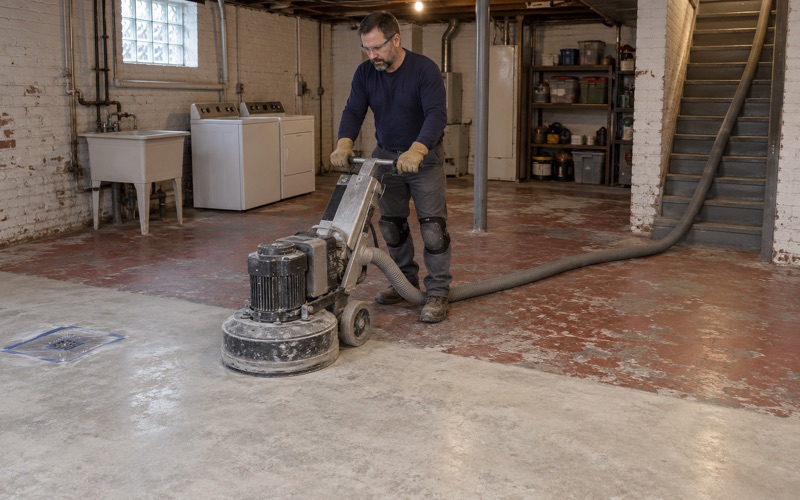
Both get the same start. A diamond grinder or a shot blaster opens the slab to a measured profile, and we skip acid etching altogether. Moisture testing sits in the written scope as its own line, and the proposal names the product, the system build and the finished thickness so the floor can be checked against the paper.
Before we put a number on anything, we read the cracks and whatever coating is already down. When the concrete needs repair or replacement first, we tell you that plainly, and we read the warranty exclusions out loud before the sale, moisture at the top of the list.
A Village-Leased Golf Course on District Land

Worth is a village in Cook County, a suburb of Chicago that counted 10,970 people in the 2020 census, and its southern edge runs along the Calumet-Sag Channel. On that water sits Water’s Edge Golf Club, at 7205 W 115th St, a public course that opened in 1999 with a clubhouse, a driving range and event space used for banquets and golf tournaments.
The address sits west of Harlem Avenue, so it falls in Palos Township rather than Worth Township, which covers the village east of Harlem. Two blocks west of Harlem on 115th Street, the Worth Village Boat Ramp puts a concrete ramp onto the same channel. For a floor job, the address matters less than the people who answer for the building, and that is where the club differs from almost any other room in town.
Three parties stand behind this one. A 2005 trade-press report described the course as owned by the Metropolitan Water Reclamation District of Greater Chicago, leased by the Village of Worth and run by a management company. That report is now two decades old, and we have not read the current lease, so we treat the arrangement as a reason to ask questions rather than as a settled chain of command.
The same report said the course was built using biosolids, was irrigated with Cal-Sag water and saw 30,000 to 40,000 rounds a year. That last figure is foot traffic, and foot traffic is what a clubhouse floor answers for. We have never worked on the club’s floors and claim no connection to it; we use it as the clearest example in Worth of a floor that no single owner controls.
The arrangement shapes the practical questions a floor job raises, from who signs to who sets the dates, and a contractor who assumes a single owner can get both wrong. The floors themselves come first, though, because their wear is what starts the conversation.
Looking for epoxy-flooring closer to Bensenville? See Epoxy-Flooring in Bensenville.
Clubhouse, Pro-Shop and Banquet-Room Floors
A clubhouse at a public course takes two kinds of abuse in the same week. Golfers come in off the turf carrying sand, grit and wet grass on their shoes, and a banquet crowd brings spilled drinks, rolled service carts and stacked chairs onto a floor that has to look clean in photographs.
Grit at the Door
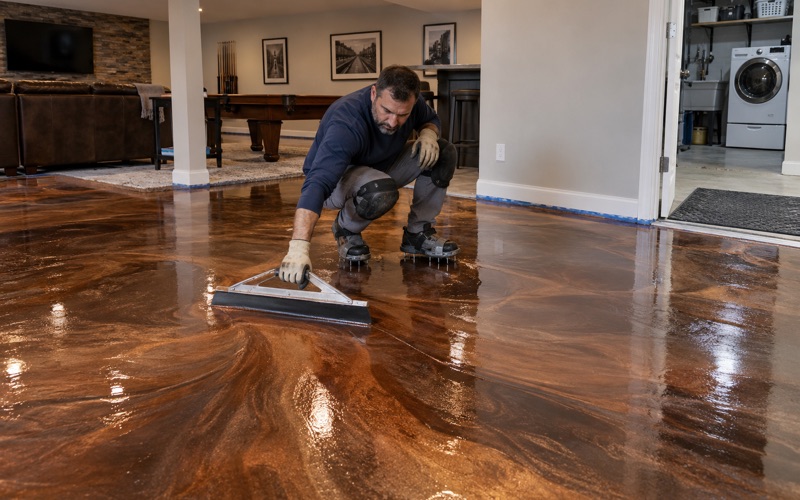
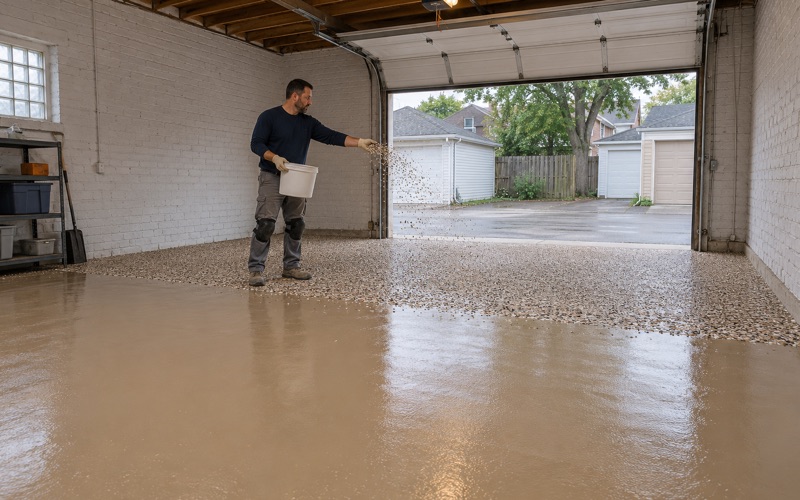
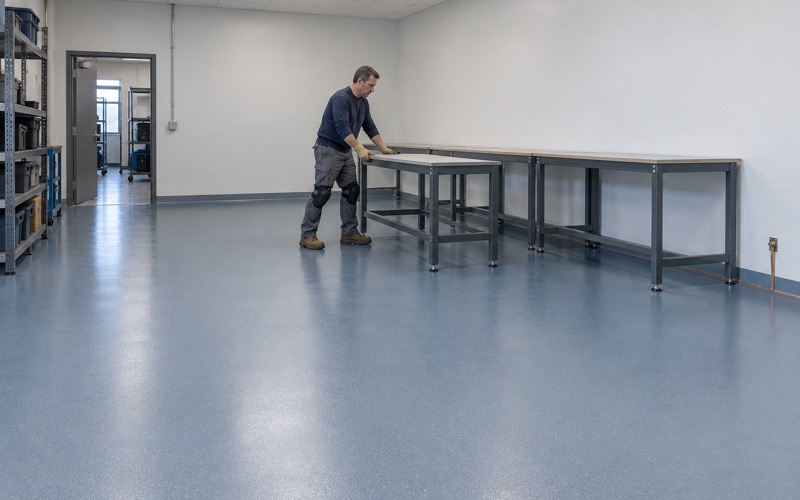
Sand and fine grit act like sandpaper under a shoe, and a thin coating scuffs through at the entry first. For entries and pro-shop aisles we lean toward a broadcast system, vinyl flake or quartz aggregate locked in a 100% solids epoxy base, finished with a polyaspartic or polyurea topcoat that holds its gloss under scuffing. Quartz gives more texture underfoot where floors stay damp, and we set the broadcast density to the room rather than to a catalog photo.
The Pro Shop’s Moving Fixtures
A pro shop rearranges racks, display tables and a checkout counter as the season changes, and those fixtures get dragged rather than lifted. That argues for a topcoat with real scratch resistance and a build thick enough that a gouge stays in the topcoat instead of reaching bare concrete. We also plan the job so fixtures come out once, the whole room is coated in one pass, and seams never land in the middle of a sales aisle.
Spills in the Event Room
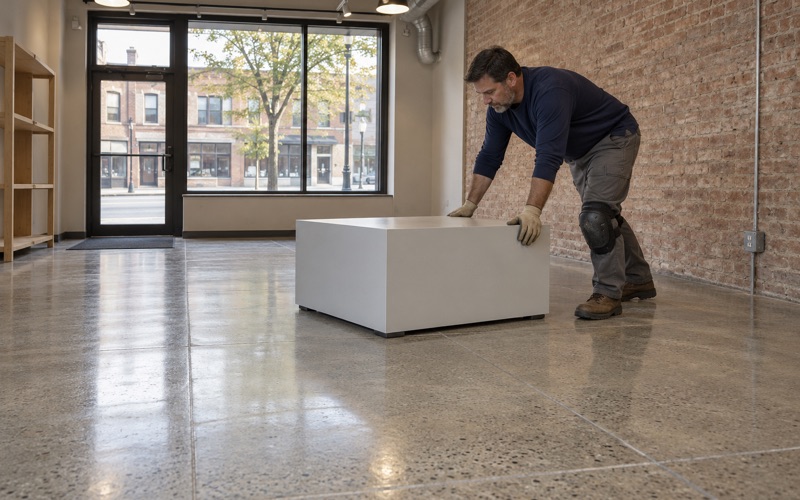
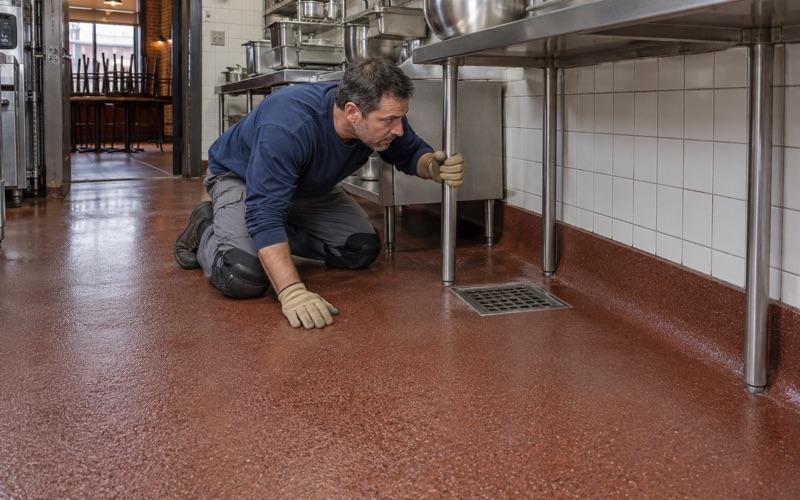
A banquet room is a different test. Wine, soda and sugary mixers sit on the floor until the cleanup crew arrives, so the coating has to be sealed tight enough that a stain stays on the surface instead of soaking in. A seamless resin floor helps here because there are no grout lines or tile edges to trap what spills, and we talk through how much slip texture the room needs before the topcoat goes down, since dancing and table service pull in opposite directions.
What the Slab Under a Clubhouse Can Hide
A building beside a channel and irrigated turf is not a place to guess at moisture. We run ASTM F2170 in-situ relative humidity probes, and where the scope calls for it an ASTM F1869 calcium chloride test, before choosing between a standard primer and a moisture-mitigation primer. If the readings say the slab is not ready, the proposal says that too, rather than a blister saying it a season later.
Three Parties, One Floor and a Booked Calendar
On most commercial jobs one owner signs the proposal. At a club arranged the way the 2005 report described, a floor change in the clubhouse could touch three parties: the operator running the building day to day, the village as lessee and, possibly, the district as landowner. Who actually has to approve a floor coating there is something we have not read in any lease, so we do not guess at it.
Getting the Right Signatures
Our practice on a floor like this is to ask the person who calls us to confirm, in writing, who else must sign off before work is scheduled. The proposal then goes to every party who needs it, carrying identical specifications, so nobody approves a different floor from the one that gets installed. A written scope that each party can check is worth more here than on a single-owner job, because three readers will each be looking for something different.
Working Around Golf Season and Events
A clubhouse floor cannot close whenever it suits the installer. Golf season fills the building with players, and the banquet calendar books the event room on its own schedule, so the realistic window is whatever gap the operator can protect. We plan grinding, coating and cure time as one block inside that gap and work overnight or across a weekend when the building has to reopen on schedule.
Cure time is set by the slab, not by the calendar. We read slab temperature and the dew point spread at the surface before each coat, because a coat laid too close to the dew point can pick up amine blush and lose adhesion at the next layer. A fast polyaspartic topcoat can shorten the return to service, but only when the readings allow it, and we say so before the date is promised. Inside a room that reopens to guests, the coatings we choose also stay within the Illinois limit on VOC content, a rule that binds the installer and not only the manufacturer.
Grinding in a building that stays partly open needs its own plan. Our grinders and shot blasters run with dust collection, the dust is bagged and hauled rather than swept outside, and nothing is washed toward a drain on a property that sits beside the channel. Doors to rooms still in use stay sealed until the last coat is down.
Back Home: Garage and Basement Floors on 1950s-1970s Slabs
Away from the course, the housing stock sets the terms for a home floor in Worth. Of the village’s 4,533 housing units, 1,157 were built in the 1950s, 1,023 in the 1960s and 1,173 in the 1970s, so about three-quarters date from 1950 to 1979 and fewer than one in ten went up in 2000 or later. Nearly every garage or basement floor here is a retrofit over a slab somewhere between 45 and 75 years old.
Old Layers and Old Cracks
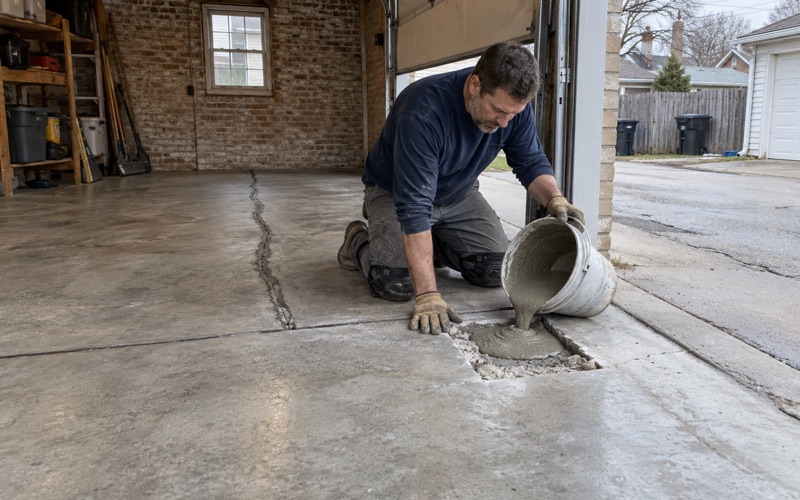
A slab that age has usually collected something: a painted garage floor, a patch from a past repair, tile adhesive left behind in a basement. We check for each before choosing a system, because a coating bonds to whatever is on top, and then grind down to clean concrete and an ICRI CSP profile the primer can grip. Cracks get read rather than filled blind, since a crack that is still moving will telegraph through any coating laid over it.
Garages Built for Winter Salt
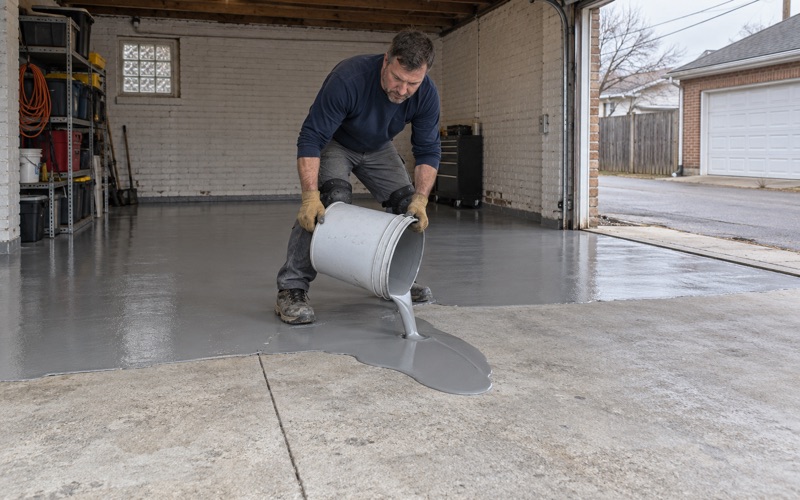
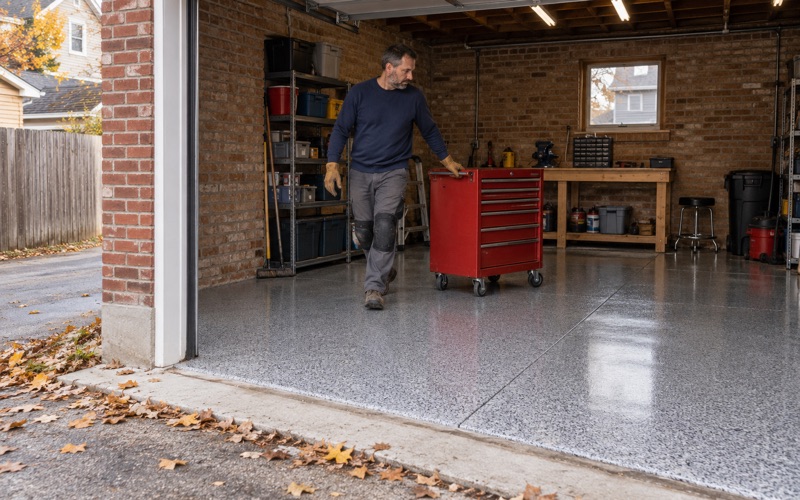
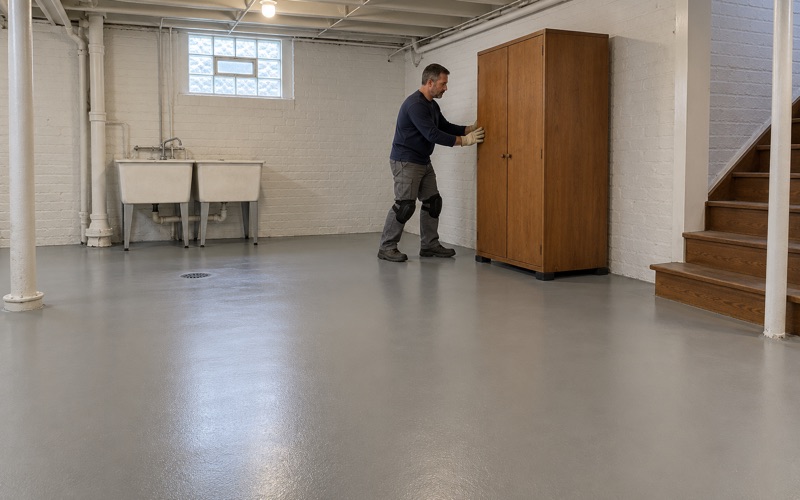
A Worth garage floor takes the calcium chloride brine and rock salt a Cook County winter leaves on tires, and that is what we build it to survive. A 100% solids epoxy base with a broadcast and a polyaspartic topcoat resists the salt and the hot tire pickup that softer garage paints suffer. Basements get moisture testing as a scoped line before any primer is picked, and we say plainly that a floor coating will not stop a sewer backup; the floor drain and backflow question comes first.
An unheated detached garage in late fall is a scheduling question as much as a coating one. When its slab cannot hold a safe margin above the dew point, we tell the owner plainly that the floor waits for spring.
Condominium Garages and Shared Rooms
Worth also has a sizable layer of apartment and condominium buildings, and in those the common garage, storage room or laundry floor belongs to the association or the building owner, not the person living upstairs. We take those jobs from whoever controls the space, put a written contract in hand before work starts, and for a home job include the Home Repair: Know Your Consumer Rights pamphlet the Illinois Home Repair and Remodeling Act requires. Tenants who still need the garage get a schedule they can plan around.
- 20+ Years Coating Floors
- Moisture Tested Before Quoting
- Free Written Estimates