Berwyn Epoxy Flooring has spent more than 20 years on epoxy flooring in Schiller Park and the surrounding suburbs, and the floors we think hardest about here are the ones that never get a chance to dry. Changing rooms, shower areas, wash bays and the concrete where wet feet land all ask more of a coating than a parked car does. Water sits on them, cleaners attack them, and the people crossing them are often barefoot.
That changes how we build a floor. A smooth, glossy finish that looks fine in a showroom can turn into a skating rink once it is wet, and a coating laid over damp or poorly opened concrete will lift at the first edge that holds water. So every job starts with the slab itself: what is on it, how wet it is underneath, and how much texture the finished surface needs to carry.
The rest of this page walks through how that plays out in a village whose busiest wet floors sit around a summer pool. It covers what those floors carry, how we keep them from getting slick, and why the calendar decides when the work can happen at all.
A Village Pool, Not a Park District Pool
In a lot of Cook County suburbs, the pool belongs to a separate park district with its own board and its own budget. Schiller Park works differently. Recreation here is a department of the village itself, with a Director of Parks and Recreation and a Recreation Board, rather than an independent taxing body.
What the village operates
The village runs three recreation facilities: the Activity Center, the Anna Montana Water Park and Memorial Pool, and the Bluthardt Recreation Center at 9638 W Irving Park Road. The pool is the seasonal one. Its 2026 season, according to the village’s summer brochure, ran from June 6 to August 23, with swim lessons, water aerobics and a splash pad on the schedule.
We mention it because it explains what kind of floor matters in Schiller Park, not because we have worked on it. We have not inspected, bid or coated anything at the pool, and nothing here should be read as a description of its current floors.
Why the ownership matters to a floor
When a village department runs a facility, decisions about maintenance run through village staff and the village calendar. The same is true for a homeowners association clubhouse, a private swim club or a fitness business with a pool. Whoever owns the floor, the questions we ask are the same: who signs off on the scope, when the room can be closed, and how long it has to stay closed while the coating cures.
Schiller Park is a small place, a village in Leyden Township covering 2.77 square miles, and it is largely built out. Almost every floor we see here is an existing slab with a history, which is why we read the cracks and the old coating before we quote rather than after.
Looking for epoxy-flooring closer to Burr Ridge? See Epoxy-Flooring Services in Burr Ridge.
Wet, Barefoot and Chlorinated
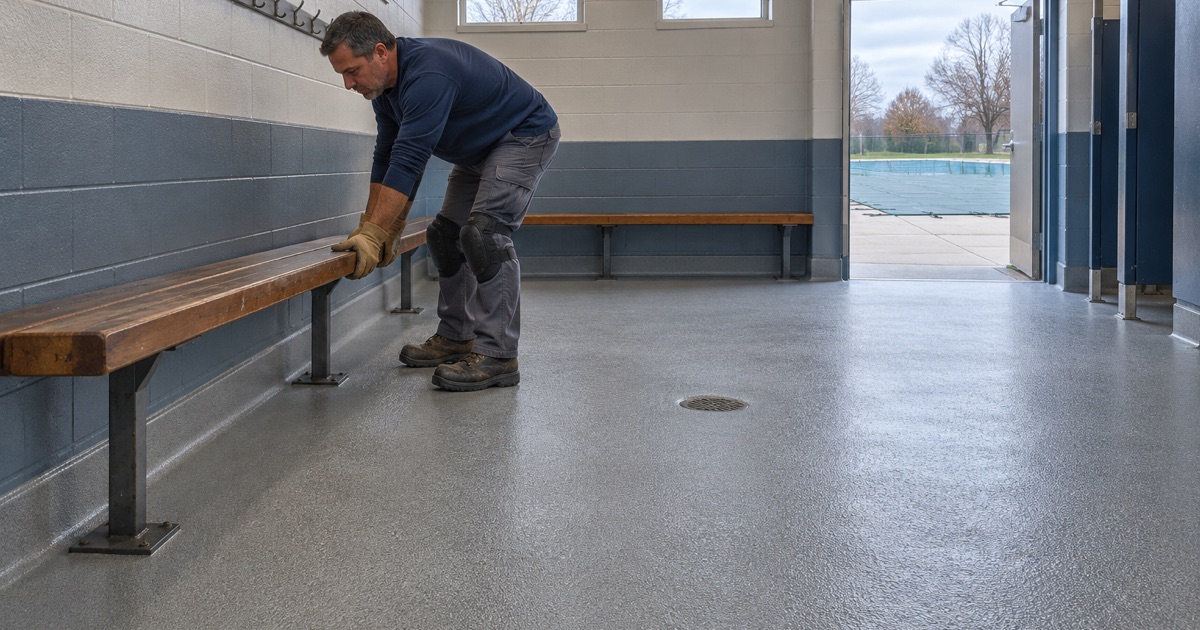
A bathhouse or locker-room floor at an outdoor pool takes a kind of punishment that a garage floor never sees. It is wet for hours at a stretch, it is crossed by bare feet all day, and it is washed down with whatever the staff uses to keep it sanitary. That combination decides the system, the texture and the prep.
Pool chemicals and cleaners
Chlorinated water drips off every swimmer who walks through, and cleaning chemicals get mopped across the floor every day of the season. A thin roll-on coating with poor chemical resistance can soften, stain or chalk under that routine. We build these floors from 100% solids epoxy with a chemical-resistant topcoat, often a polyaspartic, and we name the product, the system build and the finished thickness in the proposal so the owner can check later that what was quoted is what went down.
Standing water and the edges
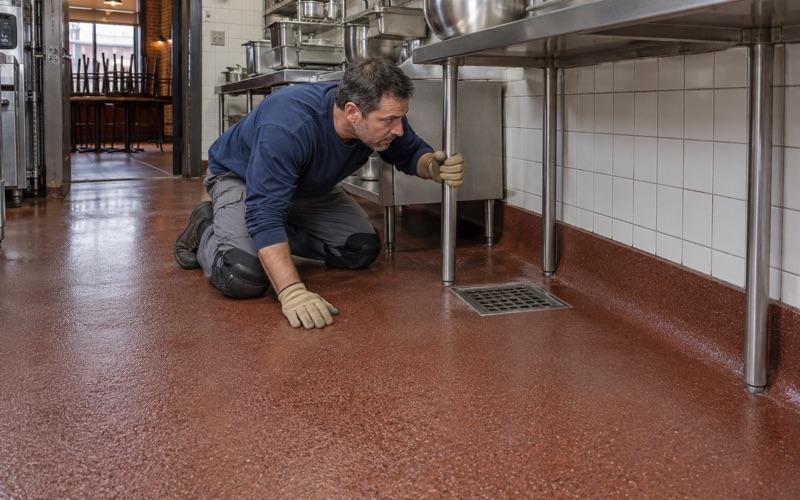
Water that sits in a low spot or creeps under a lifted edge is how a floor coating starts to fail. Before we quote a wet room, we look at where the water goes: toward the floor drain, toward a wall, or nowhere at all. Drain rims, the base of walls and the transition at a doorway get detailed so the coating terminates cleanly instead of leaving a lip that collects water.
Slip resistance you can feel through bare feet
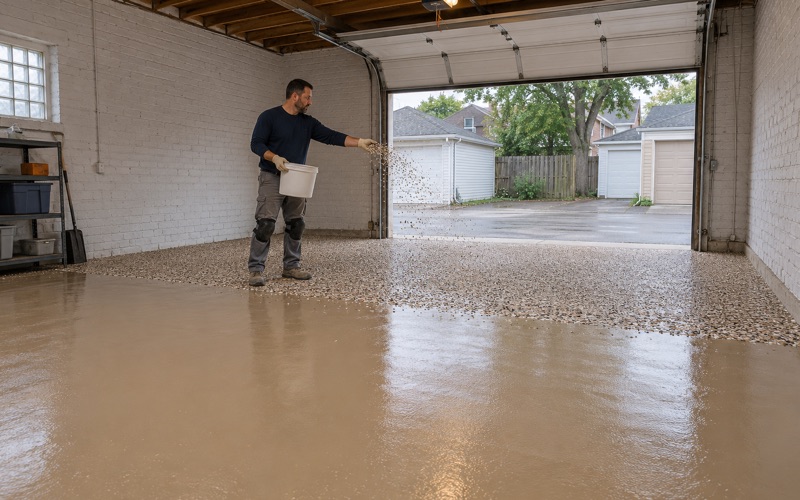
Bare feet on a wet floor need texture, and the texture has to be built into the coating rather than painted on top of it. On wet-room floors we broadcast quartz aggregate into the epoxy and lock it in with the topcoat, which gives a surface that grips without tearing up skin. A vinyl flake broadcast can add color, but on its own it is usually too smooth for a pool deck or shower area.
There is a trade-off, and we say it out loud. More grit means more grip and a floor that is harder to mop, so we talk through how the room is cleaned and who walks on it before settling the texture. We do not quote a particular slip rating as a rule for these rooms, because no code requirement for this village was part of what we reviewed.
Late August to Early June: The Only Window
A seasonal outdoor pool sets its own schedule for floor work. Once the gates open in early June, the bathhouse is in daily use until the season ends in late August, and nobody wants a locker room closed for coating on a hot July weekend. The closed season, roughly the nine months between, is when any recoating has to happen.
Opening the slab properly
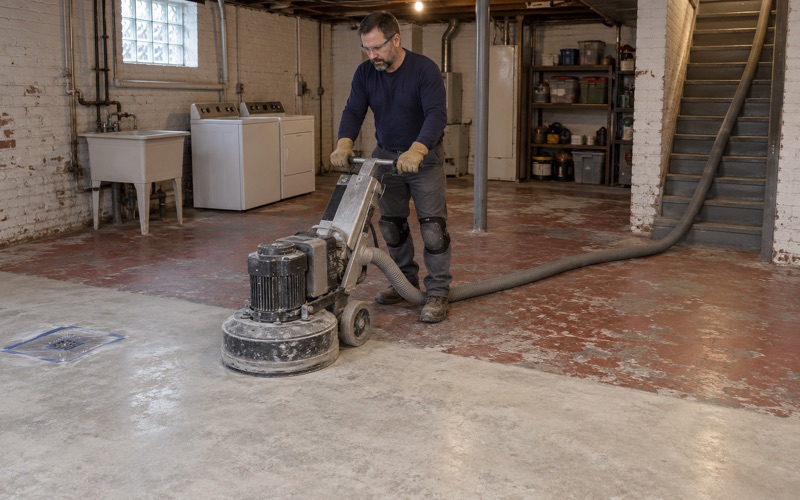
That closed-season window gives time for the prep we insist on. Every slab is opened mechanically, by diamond grinding or shot blasting, to a measured ICRI CSP surface profile, and we never acid etch. On an old bathhouse floor that may mean grinding through layers of paint and failed coating, and if the concrete underneath is cracked, spalled or soft, we say plainly that it needs repair, or in some cases replacement, before anything gets coated.
Moisture is a line item
A floor that has been soaked all summer and sits on grade can hold a lot of water in the slab. We test it, using ASTM F2170 in-situ relative humidity probes or ASTM F1869 calcium chloride testing, and the test is written into the scope rather than sold after a coating has blistered. If the readings are high, a moisture-mitigation primer goes down first, and the warranty exclusions are read out before the job is signed, with moisture named at the top of the list.
Temperature and dew point decide the date
The catch with an off-season window is that much of it is cold. An unheated bathhouse in January can hold a slab too cold for epoxy to cure properly, and a surface sitting close to the dew point can collect condensation and amine blush. We schedule the cure against slab temperature and the dew point spread at the surface, not against the calendar, which in practice often means fall soon after closing or spring before opening.
Cure, Odor and Ventilation Before the Gates Open
A coating that is dry to the touch is not the same as a coating that is ready for chemicals and foot traffic. Epoxy keeps hardening for days after it looks finished, and a wet room asks for full chemical resistance on its first busy afternoon. We build the cure time into the schedule so the last coat is not going down the week before opening day.
Ventilation and odor
Coating work produces odor and needs airflow, especially in a closed-up bathhouse or a basement with small windows. We plan ventilation with the owner before we start, and we choose coatings within the Illinois limit on VOC content, a limit that applies to the installer as well as the manufacturer. Grinding dust is collected at the source with vacuum equipment, never hosed toward a floor drain.
Handing the room back
Before the floor goes back into service, we walk it with whoever manages the room. We check the drain rims and wall edges for clean terminations, wet a section to show how the texture feels underfoot, and go over how to clean the surface without dulling the topcoat. We also leave a written note of the cure dates and any areas we flagged during prep, so whoever plans the next closed-season project knows what is under the coating.
For a floor that sees heavy chemical use, we also talk about upkeep. A chemical-resistant topcoat can be refreshed over a scuffed, well-bonded base during a later closed season, which is a far smaller job than grinding the whole system off. Catching wear early is what makes that possible, so we tell owners what to watch for along the wettest paths.
The same thinking at home
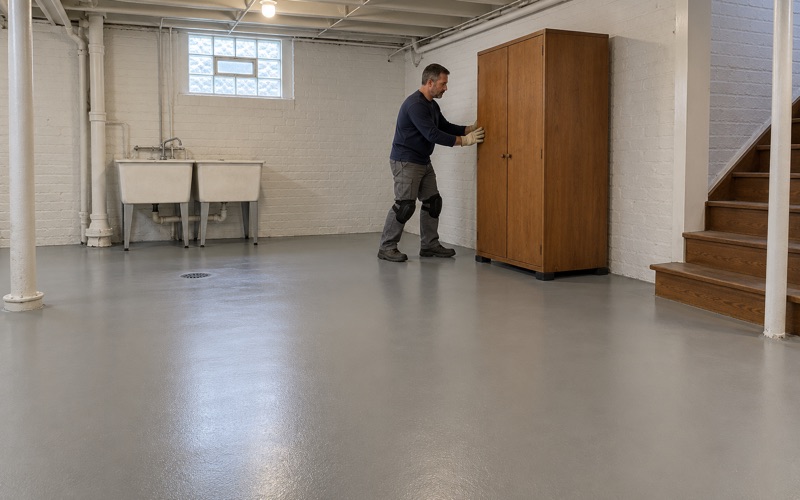
The homes here are mostly older, with the bulk of the housing built in the 1950s and 1960s and nothing new since 2010, so residential work is recoat and repair on existing slabs. A basement laundry area or a mudroom by the back door gets the same treatment as a wet commercial room: grind, test for moisture, build in texture where feet will be wet. Every home job comes with a written contract and the state’s consumer-rights pamphlet, as the Illinois Home Repair and Remodeling Act requires, and we are plain that a floor coating does not stop a sewer backup. If water has come up through a floor drain before, we point to the drain and the backflow question first.
- 20+ Years Coating Floors
- Moisture Tested Before Quoting
- Free Written Estimates