Berwyn Epoxy Flooring has spent more than 20 years on epoxy flooring in Midlothian, and the first thing we ask about a basement or garage here is how water reached it last time. That answer shapes the whole job. A slab that took on creek water, one that sat under a sewer backup and one that stays damp from below can look alike from the stairs, but they call for different next steps.
A coating is a sound last step after some of those events and the wrong one after others. We would rather tell you that before a proposal than after a floor has blistered.
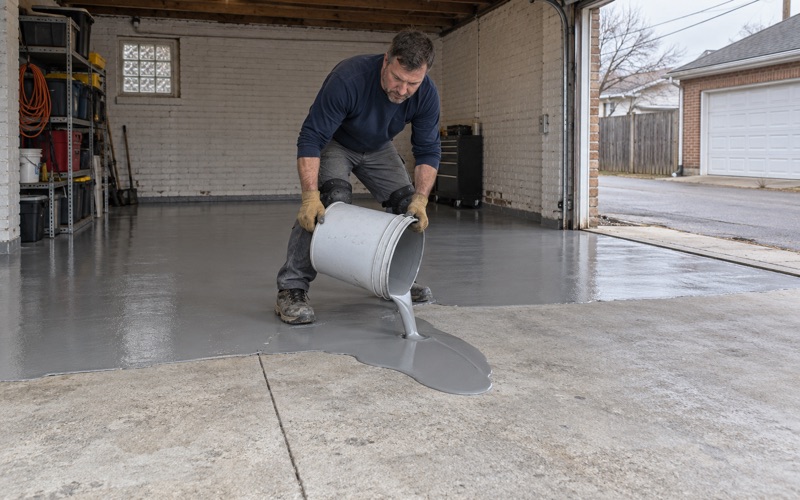
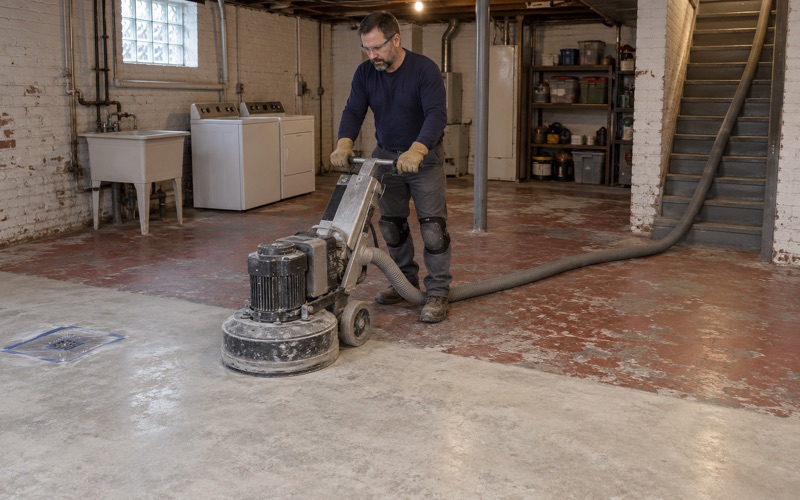
Every slab we coat is opened with a diamond grinder or a shot blaster, never acid. Every proposal names the product, the system build and the finished thickness, and we read the warranty exclusions aloud before you sign, moisture first. What follows is how we read a Midlothian floor before any of that begins.
Three Ways Water Reaches a Midlothian Basement
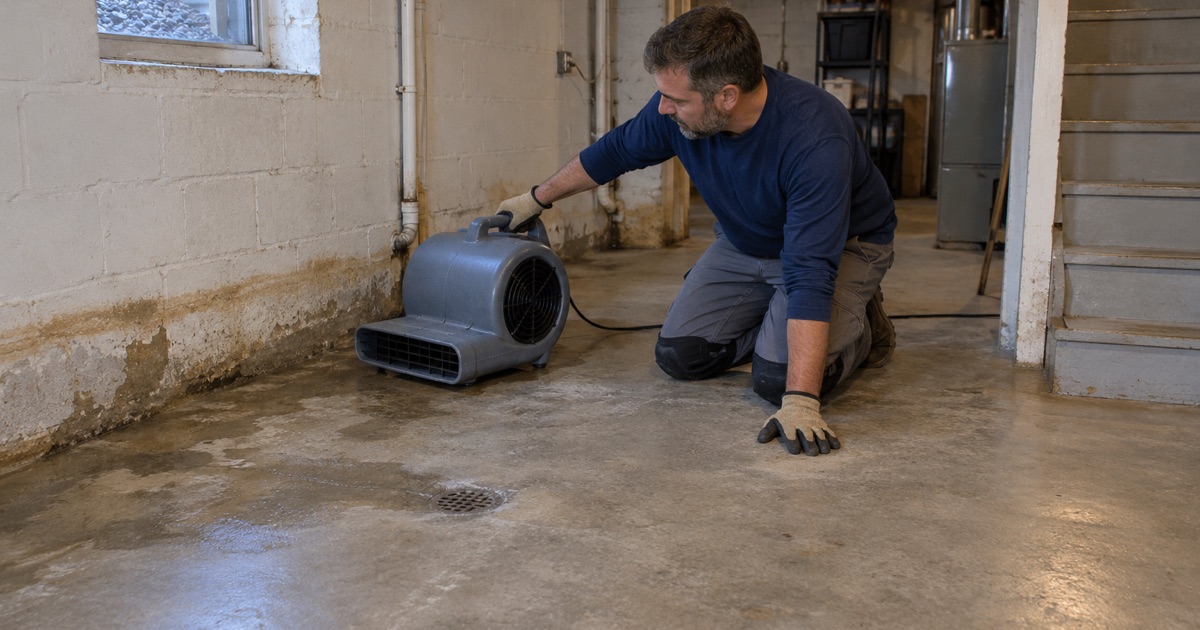
Midlothian adopted a RainReady plan on January 28, 2016, and it is unusually direct about the village’s water problems. It names three of them separately: Natalie Creek overbanking, sewer system backup and groundwater seepage. In the survey behind the plan, 85 percent of residents said they were concerned about water problems, and the summer of 2014 brought nine flood events in 15 weeks.
We find that split useful because each route leaves a floor in a different state. Creek water arrives from outside and leaves silt behind. A sewer backup leaves contamination that has to be dealt with as a cleanup before anyone talks about finishes. Seepage is different again, because the water is coming up through the slab rather than across it.
Natalie Creek, Midlothian Creek and Tributary Creek
The village’s 2024 hazard mitigation annex to the Cook County plan maps flood-prone areas along all three creeks. The Natalie Creek area sits between 147th and 149th at Cicero. The Midlothian Creek area runs from 149th to Waverly Avenue between Keeler and Kenton, and the Tributary Creek area from LaVergne to Central between 145th and the Midlothian Turnpike.
The annex also lists six FEMA repetitive-loss properties in the village, all single-family homes, and street flooding at spots such as 150th and Kilbourn and 146th and Kilpatrick. If your house sits near one of these areas, we want to know whether the last water came over the yard or up through the floor drain.
The MWRD Project and What It Does Not Promise
The Metropolitan Water Reclamation District’s Natalie Creek project is a $7.63 million effort covering 15,800 linear feet, aimed at reducing flooding for 237 structures in a 100-year storm. In 2014 Midlothian flooded five times in nine weeks from storms of one-year size or less. Work in the village includes upsized culverts at 149th Street near Kilpatrick and a basin expansion at 149th and Kilpatrick.
The project broke ground in 2018, and we found no final completion date. We do not tell any homeowner that the creek problem is behind them or that a house is now protected, and a new floor should be planned as though water could return.
Looking for epoxy-flooring closer to Lemont? See Epoxy-Flooring Services in Lemont.
After a Sewer Backup or Creek Water: Clean, Dry, Then Decide
A floor coating is never the first call after water comes in. Sewer backup in particular leaves a contamination problem, and the slab has to be cleaned, disinfected and dried before anyone grinds it. Grinding a slab that still holds sewage residue only spreads it into the dust and into the profile we are trying to create.
We also say plainly that a coating will not keep a backup from happening again. The floor drain and the backflow question come first, and those are plumbing decisions, not flooring ones.
We ask who did the cleanup and when, and whether drywall, carpet or old flooring came out with it. A slab that was covered when the water arrived may have trapped moisture under that covering, and it needs time open to the air before it can be tested fairly.
Creek Water and Silt
Overbank water from Natalie Creek or Midlothian Creek arrives carrying silt and whatever it picked up on the way. Once the mud is out, we look at what the water did to the existing surface: lifted paint, softened patches, adhesive that let go, or efflorescence blooming as the slab dries.
A slab that took one flood and dried out fully is often a fair candidate for a coating. A slab that has flooded repeatedly needs a frank conversation first, because a floor that goes under again will need cleaning and possibly repair whatever finish is on it.
Drying Is Measured, Not Assumed
A slab that looks dry on the surface can still hold a great deal of water a few inches down. We let it dry and then test it, rather than going by days on a calendar, and we schedule the coating itself against slab temperature and the dew point spread at the surface. Coating too close to the dew point invites amine blush, and coating over a slab still giving off moisture invites blistering.
Once the slab passes, the system build follows from what the water did. A basement that has flooded more than once may be better served by a thinner, easily recoated system than by a thick build that would be costly to remove after the next event, and we put that tradeoff in writing so you can weigh it.
Seepage from Below: Test the Slab Before Coating
Groundwater seepage is the route a surface coating does not fix. When water is pushing up through a basement slab under hydrostatic pressure, an epoxy film on top does not remove the water. It traps it beneath the coating, and the bond fails from underneath as bubbles, peeling or soft spots.
That is why moisture testing is a priced line item in our proposals rather than something offered after a failure. On a Midlothian basement with any history of dampness, it is the step that decides what system goes down, or whether anything should yet.
Three Tests, Three Different Readings
We start simply with the ASTM D4263 plastic sheet test, which shows whether moisture is condensing under a taped square of film. It is a quick screen, not a number. Where the slab warrants it, we follow with ASTM F1869 calcium chloride testing for the moisture vapor emission rate, or ASTM F2170 in-situ relative humidity probes set into drilled holes in the slab.
We compare the readings against the coating manufacturer’s published limits and against ASTM F710 moisture thresholds where they apply. A reading over the limit is not a reason to coat and hope. It means a moisture-mitigation primer goes into the system build, or the job waits until the water source is dealt with.
Where a basement slab tests high but the water source has been handled, some owners choose urethane cement, which tolerates more moisture in the slab than a standard epoxy system. It is still not a cure for active seepage, and we price it only after the readings support it.
When the Answer Is Not a Coating
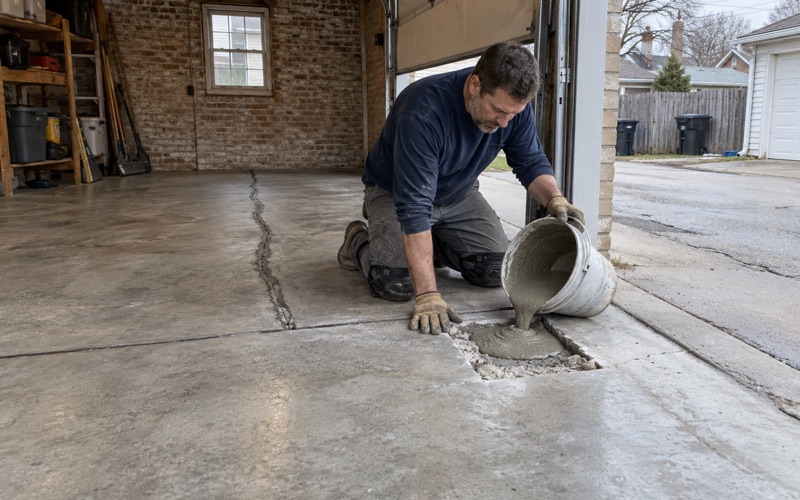
Sometimes the test confirms that water is still moving through the slab, and the honest answer is that the floor needs drainage, sump or foundation work before any finish is worth buying. We say so rather than selling a floor that will lift. We also read the cracks and any old coating, and when a slab needs repair or replacement first, the proposal says that plainly.
None of this is a promise that a finished floor keeps water out. A coating is a wearing surface, and in a village with three distinct water routes, we treat it that way.
Flood-Zone Floor Work and Older Midlothian Floors
The Building Commissioner Makes the Call
Midlothian’s flood damage prevention ordinance, adopted in 2008, makes the Building Commissioner the floodplain administrator, working through the village Building Department at 14801 South Pulaski Road. Inside a mapped flood hazard area, the code counts repairs and improvements cumulatively over ten years against a line of 50 percent of the building’s market value.
The code also says substantial improvement begins with the first alteration of any wall, ceiling or floor. Whether a particular floor job counts toward that tally is the Building Commissioner’s determination, not ours, so on a property in a mapped area we ask you to check with the Building Department before the job is scheduled.
Village Rules and Paperwork
Illinois issues no state license for flooring or coatings work, so we confirm Midlothian’s own requirements before scheduling: the annual village contractor license, the $10,000 bond and the liability certificate naming the village. Inspections there run Monday through Friday only, with one business day’s notice. Every home job also gets a written contract and the state’s consumer rights pamphlet before work starts, as the Illinois Home Repair and Remodeling Act requires.
Basements and Garages in a Pre-1980 Village
By Census estimates, 81.3 percent of Midlothian’s housing was built before 1980, and none since 2010. Every basement and garage floor we see here is a retrofit over an older slab, and many of those slabs have already been through earlier water events.
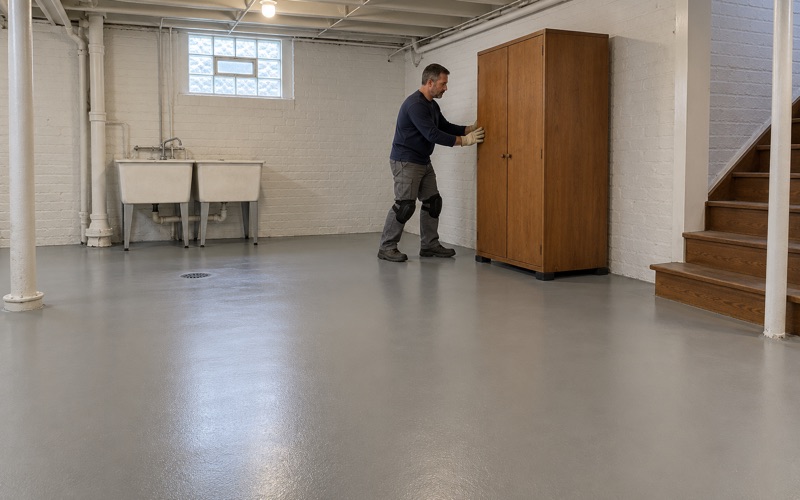
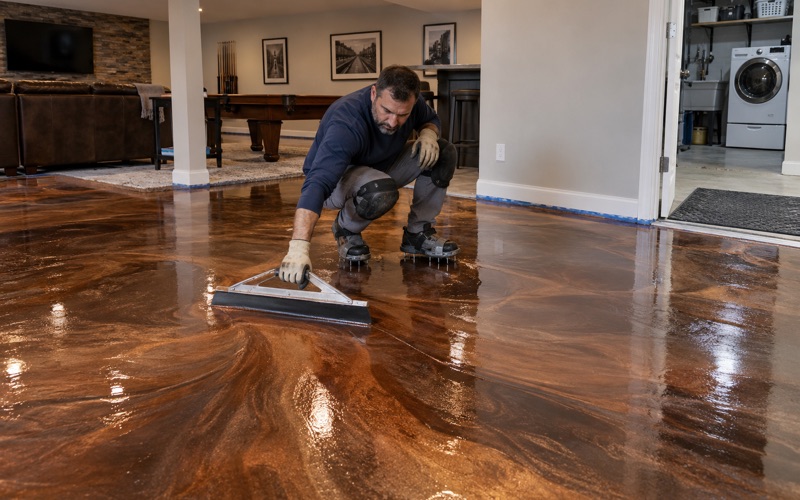
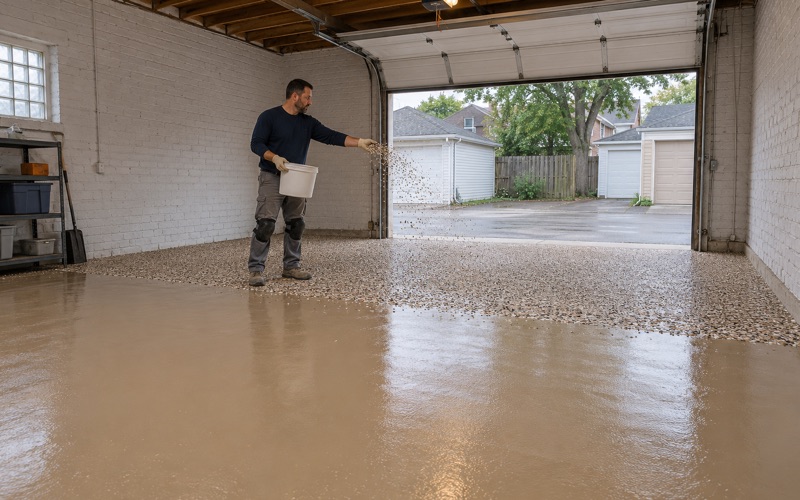
In a basement that means checking for old paint, patches and adhesive before a system is chosen, because each layer is something a new coating could fail on. Our diamond grinding takes the slab down to a clean profile in the ICRI CSP range the product calls for, and a 100% solids epoxy base with a quartz aggregate broadcast gives a basement floor a textured surface that cleans up easily.
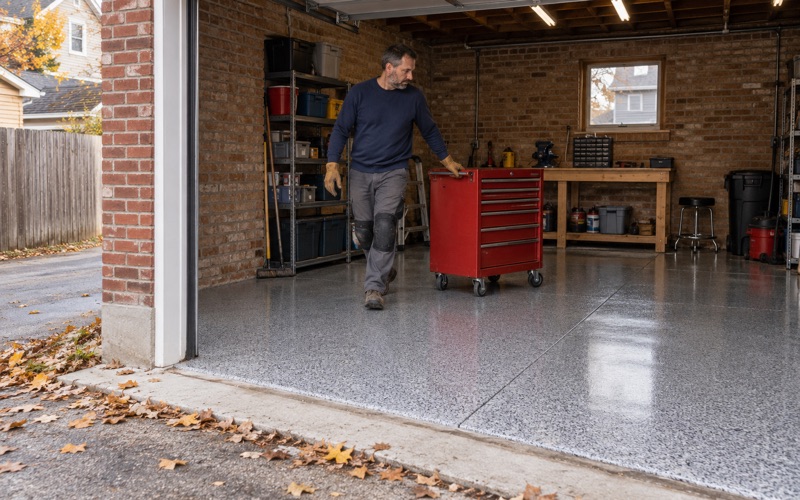
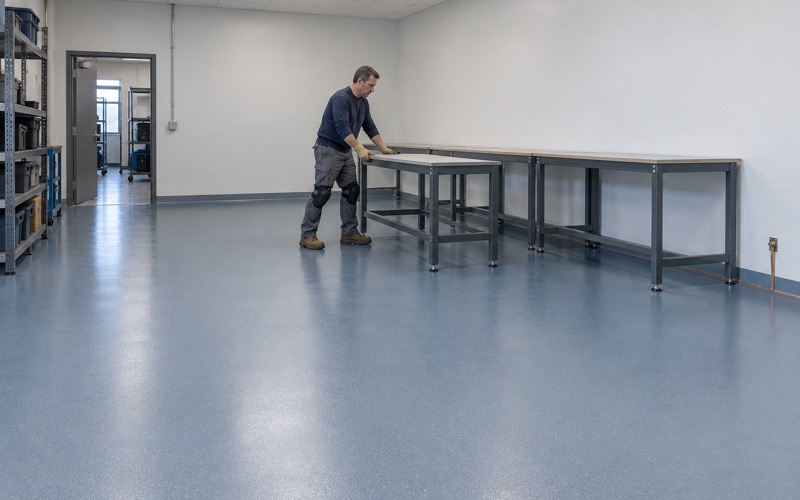
Most Midlothian homes are detached single-family houses, and the garage is often the second slab on the same quote. If the garage is unheated, the coating cures on the slab’s schedule rather than ours, and we say plainly when that means waiting for spring. When the slab is ready, a vinyl flake broadcast under a polyaspartic topcoat resists hot tire pickup and hides grit between cleanings. Every coating we use falls within the Illinois limits on VOC content, which bind the installer as well as the manufacturer, and grinding dust is collected on site rather than washed toward a drain.
- 20+ Years Coating Floors
- Moisture Tested Before Quoting
- Free Written Estimates