Berwyn Epoxy Flooring brings more than 20 years on concrete to epoxy-flooring in Lyons, and much of what we scope here is not a showroom floor. It is a service bay, a repair shop or a warehouse aisle where a coating has to carry trucks and shrug off what leaks out of them. On those floors the order of questions changes: what spills, what rolls in, and how many hours the building can give up all come before anyone talks about color.
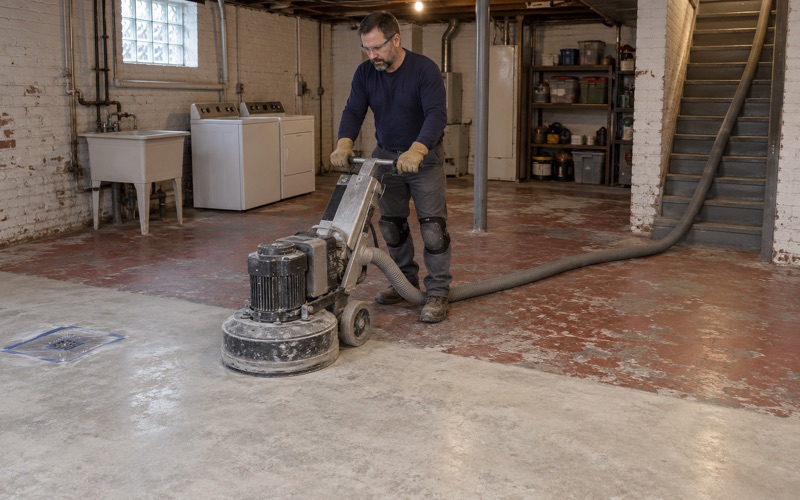
Every slab we coat is opened mechanically with a diamond grinder or a shot blaster first. We do not acid etch, because acid leaves an uneven profile and residue in a floor that is about to see fluids. Our written proposal then names the product, the system build and the finished thickness, so a fleet manager or a building owner can hold what was quoted against what actually went down.
Before we put a number on paper, we read the cracks, the joints and whatever coating is already on the floor. If a slab needs repair or replacement before it can carry a coating, we say that in plain terms instead of selling a system over the problem.
47th Street and Lawndale Avenue: the Lyons That Works on Trucks
Most people picture Lyons, a village of 10,817 at the 2020 census, as blocks of houses. Its north side tells a different story. Along W. 47th Street and Lawndale Avenue sits a working truck strip, and the addresses on it geocode inside the village itself, in Lyons Township, Cook County.
That matters for flooring because the floors on this strip are built for a different job than a home garage. A residential floor is judged on looks and on what a pair of car tires tracks in. A service-bay floor is judged on whether it survives diesel, hydraulic fluid, steel jack stands and heavy tires turning on it every day.
A 73-door terminal with a drive-through maintenance building
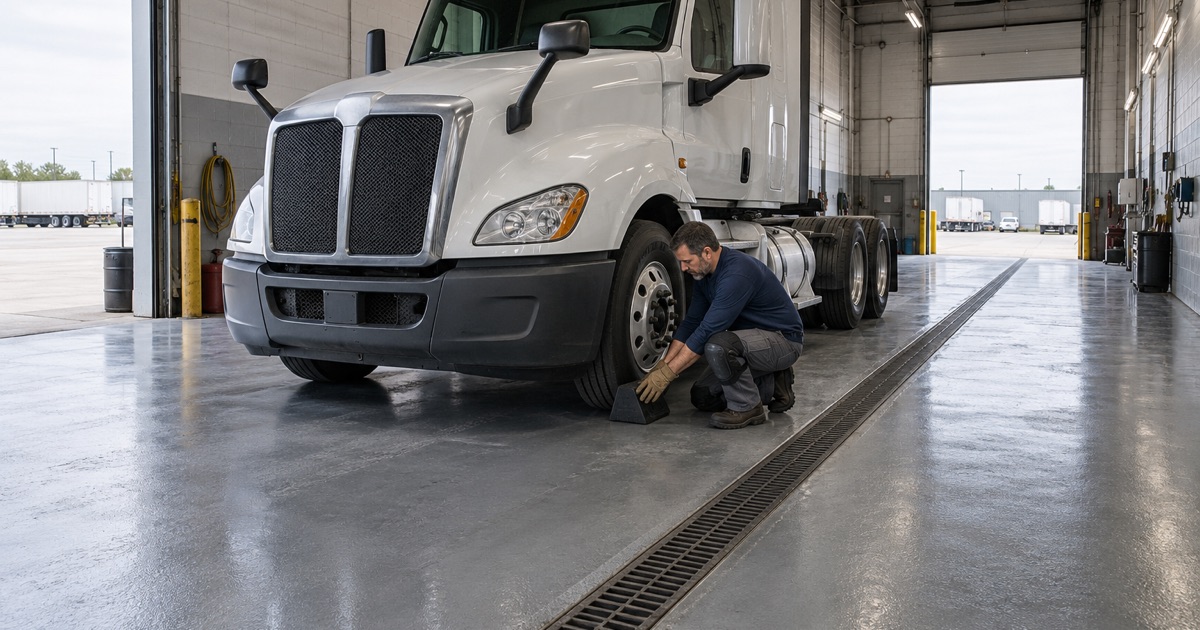
At 4711 Lawndale Avenue stands a 73-door truck terminal with a drive-through truck maintenance facility. A drive-through layout means tractors enter at one end and leave at the other, so the whole length of the bay sees rolling load, braking and turning rather than a single parking spot.
We do not know the condition of that slab or of any coating on it, and we do not claim the operation as a customer. We describe it because it is the clearest local example of the floor type this page is about. A truck maintenance lane in Lyons is a working surface first and a finish second.
Space marketed for tractor repair
On the same strip, 8001 W. 47th Street is a 60,577-square-foot building on 8.42 acres with 14-foot drive-in doors, clear heights from 14 feet 6 inches to 18 feet, and full sprinklers. It was listed as available in March 2026 for tractor repair, warehousing or light manufacturing, split into a unit of about 40,024 square feet and another of about 19,554 square feet.
Those three uses ask three different things of a floor. A tenant moving into a space like that is choosing a floor system at the same time as a lease, and the right build for a tractor repair shop is not the right build for racked storage.
Looking for epoxy-flooring closer to Brookfield? See Brookfield Epoxy-Flooring.
Inside a Truck Maintenance Bay
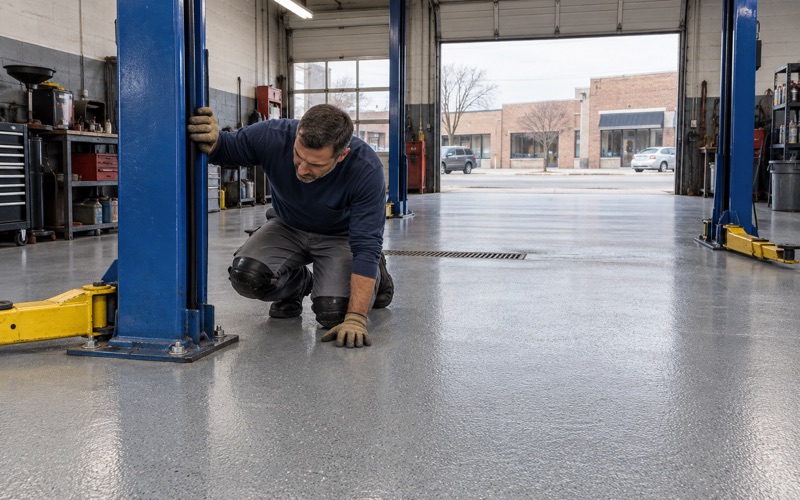
Walk any heavy-vehicle bay and the floor tells you its history in stains. There are drips under the engine position, a trail from the fluid cart, and dark arcs where tires turned under load. A coating in that room is a chemical and impact barrier, and the system has to be chosen for that job.
Diesel, hydraulic fluid and the rest of the drip pan
Diesel, motor oil, hydraulic fluid, coolant and brake cleaner all end up on a service floor eventually. Bare concrete soaks them up, which is why an old shop slab can look dry and still bleed oil into anything laid over it. Part of our pre-quote read is finding out how deep that contamination goes and whether grinding will reach clean concrete.
For the coating itself, we look at a 100% solids epoxy base with a chemical-resistant topcoat, or at urethane cement where the room sees heavier fluid exposure, washdowns or heat. The proposal names which one and why, because the difference between them shows up years later, not on day one.
Hot tires and heavy loads
A tractor that has just come off the road brings hot tires into the bay. Softer coatings can suffer hot tire pickup, where warm rubber bonds to the film and lifts it when the truck pulls away. In a drive-through bay, where every vehicle crosses the same path, that failure repeats until the lane is bare.
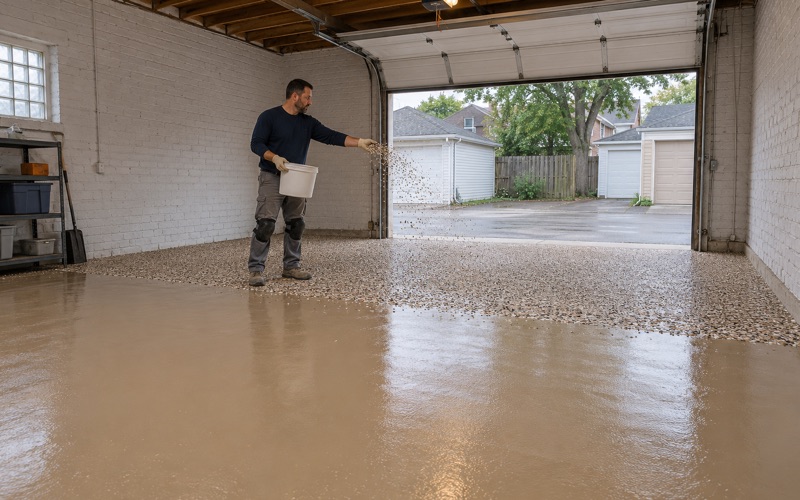
We answer it with film thickness, a well-ground substrate and a topcoat suited to tire traffic, often a polyaspartic or polyurea finish over the epoxy body coat. A quartz aggregate broadcast between coats adds texture for wet boots and gives the system more body to resist wear.
Steel on concrete
Jack stands, floor jacks, creepers, dropped wrenches and the occasional dropped part all land on a service-bay floor. A thin coating chips at every impact point and then lets fluid under its edge. Thickness, aggregate and a sound bond to an open ICRI CSP surface profile are what keep that from spreading across the room.
Drive-In Doors and the Floors Behind Them
The stretch of slab just inside a drive-in door works harder than the rest of the building. Every vehicle crosses it, it sees whatever weather the door lets in, and it is where water, grit and fluids land first.
The slab at the door line
At a 14-foot drive-in door the threshold area takes turning tires, braking loads and whatever drips off a vehicle that has just come in. That band of floor often shows wear, cracking and lifted coating long before the middle of the bay does. We read it separately when we walk a building, and we price repair there as its own line rather than averaging it into the square footage.
Cure conditions at the door line differ too. With doors cycling, the slab surface near the opening can sit closer to the dew point than the slab deeper inside, so we measure the dew point spread at the surface where the coating will go rather than reading a single thermostat. Too narrow a spread invites amine blush on an epoxy, a waxy film that weakens the bond of the next coat.
Moisture testing as part of the scope
A commercial slab may or may not have a vapor retarder under it, and nobody can tell by looking. We include moisture testing in the scope from the start, using ASTM F2170 in-situ relative humidity probes or ASTM F1869 calcium chloride testing depending on the slab and the schedule.
If the numbers come back high, a moisture-mitigation primer goes into the system build before the body coat, and the proposal says so. That keeps a moisture problem from turning into a blistered floor and an argument six months after the trucks are back on it.
Warehouse and distribution floors next door
Not every unit on 47th Street will be a repair shop. A warehousing tenant needs a floor that resists forklift wheels and pallet drag, sheds dust, and stays easy to sweep. For some of those rooms a ground and densified slab with a lithium silicate densifier is the honest answer, and a full coating is not needed.
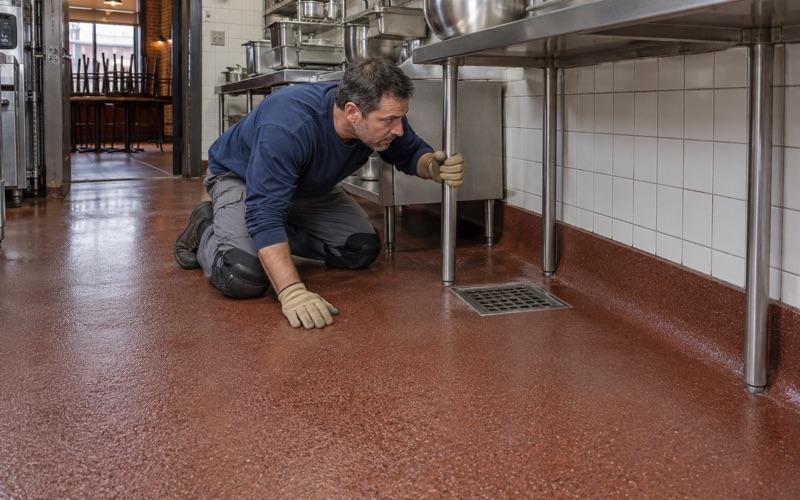
Where a unit handles food, the floor question changes again. The FDA Food Code expects coved, closed floor and wall junctures in food areas, and food establishments in Lyons answer to the Cook County Department of Public Health. We build the cove into the system rather than leaving a seam at the wall.
Scheduling Around Trucks That Cannot Stop
A truck terminal or a repair shop does not close for a week so the floor can be done. Freight still moves and tractors still need service, so the schedule is part of the job we are bidding.
Phasing bays and working off-hours
We phase work bay by bay so part of the building stays open while another part is ground, coated and cured. Where an operation needs every bay during the day, we work overnight and weekend windows and plan the cure so a bay returns to service when the shop expects it, not when it happens to be dry.
The proposal shows that sequence: which bays close, for how long, and what return-to-service time each coat needs before it can take foot traffic, then light vehicles, then a loaded tractor. Polyaspartic topcoats can shorten that window, and we say when the trade-off is worth it.
Coatings in an occupied building
People keep working in the rooms next to the one being coated, so odor and emissions matter. Lyons sits in the Chicago 2015 ozone nonattainment area, and Illinois limits the VOC content of architectural coatings under 35 Ill. Adm. Code Part 223 Subpart C, a rule that binds the installer as well as the manufacturer. We choose products within that limit and name them in writing.
Where a tenant buildout calls for permits or an occupancy certificate, that review belongs to the Village of Lyons Building Department at 4200 Lawndale Avenue. We confirm what that office requires before the work is scheduled rather than after.
The warranty conversation, before the sale
Every coating warranty has exclusions, and we read them out before a job is sold rather than after something fails. Moisture comes first on that list, followed by chemical exposure beyond what the system was specified for and damage from impact or dragged equipment.
A service-bay floor in Lyons will take abuse; that is what it is for. The goal is a system matched to that abuse, a scope that shows what was tested and built, and an owner who knows exactly what the floor was designed to handle.
- 20+ Years Coating Floors
- Moisture Tested Before Quoting
- Free Written Estimates