Berwyn Epoxy Flooring brings more than 20 years of work to epoxy flooring in Lincolnwood, where storefront and restaurant floors now raise a question beyond color and finish. Before we quote one, an owner may want to know how the bid will read to a village reviewer as well as to the person signing the check.
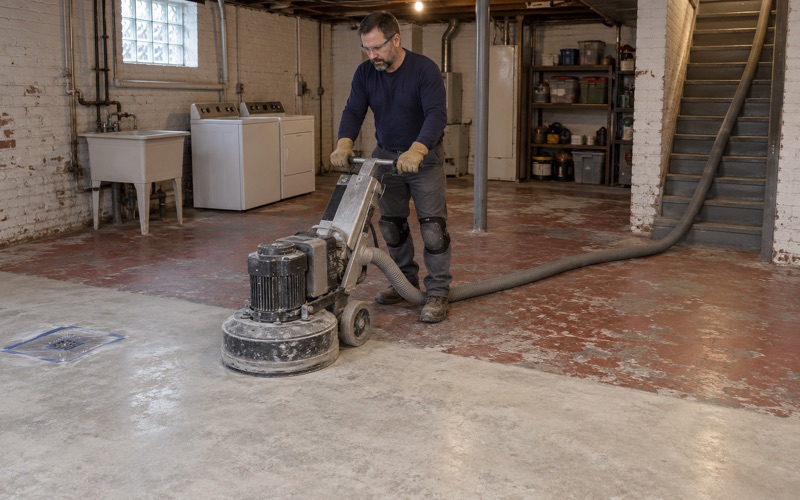
Every floor we install starts the same way: the slab is opened with a diamond grinder or a shot blaster, never acid, and moisture is tested as a priced line rather than discovered after a blister. Our proposal names the product, the system build and the finished thickness. That habit happens to be exactly what a grant reviewer needs to see on paper.
This page is about one document in particular: a grant program the village drafted in early 2026 for businesses in its Devon/Lincoln TIF District. The draft does not settle whether a resinous coating qualifies. What it does settle is how a qualifying floor job has to be bid, documented and paid for.
A Village Grant That Names Flooring
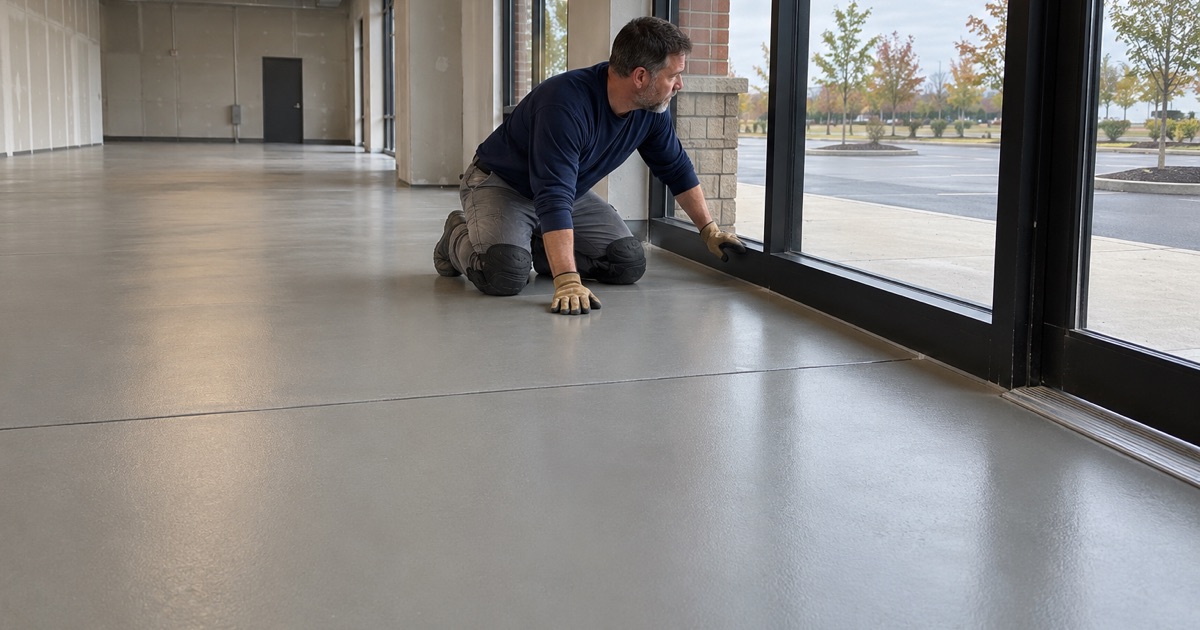
Lincolnwood is a Cook County village of 13,463 people at the 2020 census, an inner suburb that shares its southern and eastern boundaries with Chicago and borders Skokie to the north and west. The draft covers a slice of its commercial streets, not the whole village.
Lincolnwood’s Economic Development Commission packet for February 25, 2026 carries the draft Devon/Lincoln TIF District Grant Program. It is aimed at sales-tax-generating businesses in existing buildings within a district of roughly 55 acres along Devon Avenue, Lincoln Avenue and the MB zoning district. The FY2026 budget carries $300,000 for this pilot, with the village noting that not all of it may be spent in the year.
The pilot sits inside a longer plan. The Devon/Lincoln Redevelopment Plan’s 23-year budget identifies $1 million to assist reinvestment in private structures, and the storefront grant is a proposed way to put part of that to work. At the February meeting it was still a draft, and we have not seen final Village Board adoption confirmed.
What the eligible-items table says
The draft’s list of eligible items includes “permanent flooring materials,” with a parenthetical that vinyl or linoleum products are ineligible. The same table names permanent kitchen infrastructure, walk-in coolers, bathrooms including ADA modifications and grease traps. It closes with any other interior improvement the grant administrator deems permanent.
For a restaurant, that grouping matters. A kitchen floor often comes up during the same build-out as the grease trap and the cooler, so the floor estimate sits beside other line items in one submittal rather than standing alone.
Who the draft is written for
The draft is not a homeowner program, and it does not reach a residential garage. It is built for a shop, restaurant or other business that generates sales tax, in an existing building inside the district. New ground-up construction is ineligible under Illinois TIF law.
The applicant also needs ownership or a lease of at least five years, and the improvements must stay in place for five years. A floor bid for a short-lease tenant may be a sound job, but it may not be a grant job, and that is worth knowing before the pre-application meeting.
Looking for epoxy-flooring closer to Alsip? See Alsip Epoxy-Flooring.
Half the Materials, a Quarter of the Labor
The draft sets two tiers. Spark Business Grants reimburse up to 50 percent of eligible materials and fixtures and up to 25 percent of labor, from a minimum grant of $7,500 on at least $15,000 invested to a maximum of $20,000 on $40,000. The Village Manager approves them.
Dream Storefront grants run from $20,001 to $100,000, the top figure needing at least $200,000 in eligible costs. Those go to the Economic Development Commission for review and to the Village Board for a decision, which adds a step beyond a manager’s sign-off.
Budgeting against two rates
On a resinous floor, much of the price is labor: surface preparation, crack repair and the installation itself. Under the draft’s rates that labor is reimbursed at a quarter rather than half, so an owner budgeting around the grant should not expect half the floor price back.
Why the estimate splits materials from labor
Because materials and labor reimburse at different rates, a lump-sum floor price is of little use to the village. The draft asks for an itemized estimate from an unrelated general contractor that separates permanent improvements from labor, submitted with floor plans.
The word “unrelated” in the draft is doing work. The estimate has to come from a general contractor with no tie to the applicant, which keeps the numbers at arm’s length.
Our proposals already break a floor into its parts, so the split is a matter of format rather than a new exercise. Grinding or shot blasting to the profile the system calls for, crack and joint repair, a moisture-mitigation primer where testing calls for one, the body coat and the topcoat each sit on their own line. The product names and the finished thickness go on the same page. When a general contractor runs the whole build-out, that floor detail carries straight into the contractor’s itemized estimate.
What a split estimate does not decide
The split tells the village what the floor costs. It does not tell anyone whether the floor is eligible, and we do not apply for grants on an owner’s behalf or promise an outcome. The owner brings the estimate to the Community Development Director, and the village does the deciding.
Approval, Permits and Lien Waivers
The draft makes a mandatory pre-application meeting with the Community Development Director the first step. Then comes a sentence every owner should read twice: “Grant approval does not authorize work to begin. All work requires proper permits and approvals.”
Nothing goes down before approval
We do not schedule grinding on a grant-track floor until the owner tells us the grant is approved and the permits are in hand. A floor installed first and submitted afterward puts the money at risk, and no coating schedule is worth that.
Permits themselves run through the village. Lincolnwood licenses contractors itself, and no permit issues until every contractor on the job is identified and registered. Illinois issues no state license for coatings work, so we confirm the village’s current license, bond and insurance requirements before a job goes on the calendar. A general contractor there holds a village license valid one year, posts a $10,000 bond, carries a $1,000,000 insurance certificate naming the village as additional insured and pays a $100 license fee.
Hired professionals only
Work done directly by the applicant is not reimbursed under the draft. Installation has to be by hired professionals unrelated to the applicant or the owner, so a weekend kit floor laid by the owner, or by a relative’s crew, falls outside it.
Getting reimbursed
The draft gives an applicant 18 months for build-out, final inspections and opening. Reimbursement then needs paid invoices and notarized final lien waivers from the contractor and every subcontractor.
On a grant-track job, plan for the flooring contractor’s waiver as part of close-out, and expect our invoice to carry the same materials and labor lines as the estimate. When the paper at the end matches the paper at the start, the village has less to reconcile.
Whether a Coating Counts as Permanent
The eligible-items table excludes vinyl and linoleum by name and says nothing either way about epoxy, urethane cement or polyaspartic systems. Whether a resinous coating counts as permanent flooring materials is the grant administrator’s call, and we tell owners so before anyone builds a budget around it.
Ask at the pre-application meeting
The cleanest route is to bring our proposal to that meeting and ask directly. A proposal naming the product, the system build and the finished thickness gives the village something specific to rule on, which a line reading “epoxy floor” does not.
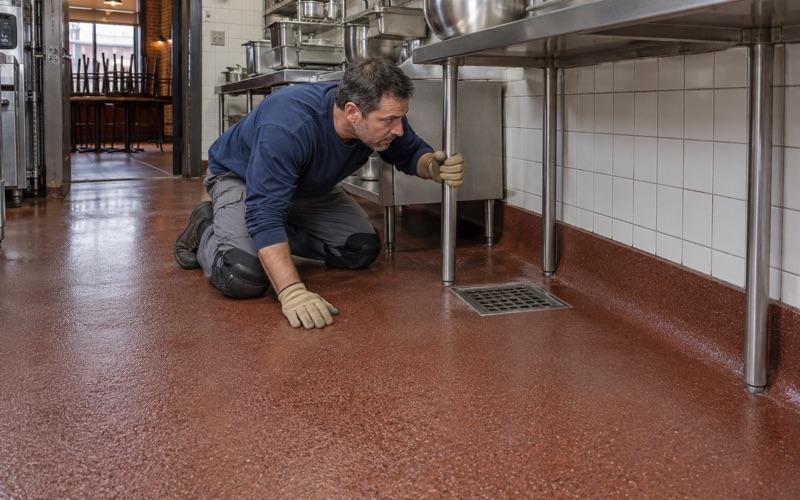
For a restaurant kitchen, the inspection side runs separately. Lincolnwood contracts with the Cook County Department of Public Health for food establishment inspections, and the FDA Food Code calls for coved floor and wall junctures, so we detail the cove base before the system is priced rather than after.
The slab under the storefront
Eligible or not, the floor itself still has to be right. An older commercial slab has often carried paint, sealer or adhesive for years, and every layer comes off under a diamond grinder or shot blaster before anything is applied. We read the cracks and the old coating first, and say plainly when a slab needs repair before it can be coated.
Moisture is tested as a scoped line, using ASTM F2170 in-situ relative humidity probes or ASTM F1869 calcium chloride testing, because the warranty exclusions we read out before signing list moisture first. Where readings run high, a moisture-mitigation primer goes into the estimate as its own materials line, which is exactly where a grant reviewer would look for it.
Products, hours and cure
A shop or restaurant that stays open during the build-out needs a schedule built around its hours. We plan grinding, coating and cure around the hours the business has to keep running, and we time each coat to slab temperature and dew point rather than a calendar date.
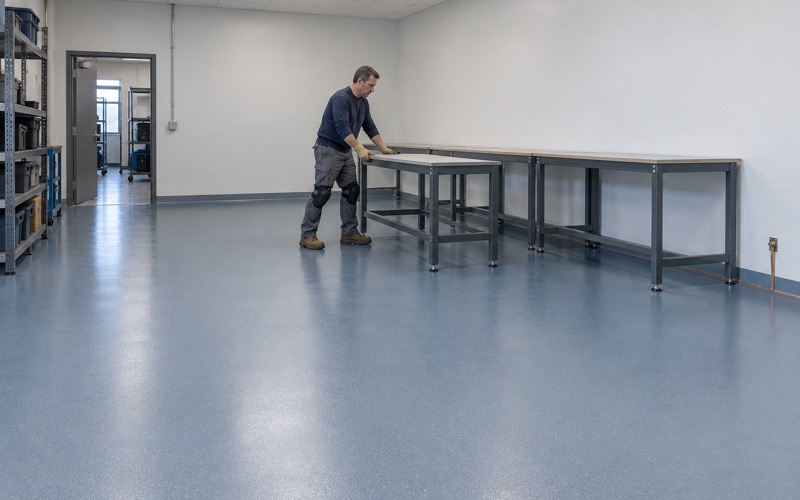
Product choice also follows the floor’s use, because a kitchen line, a retail aisle and a back stockroom do not wear the same way. In a kitchen we generally build with a quartz aggregate broadcast in the body coat for slip resistance, sealed under a topcoat, rather than a smooth gloss that turns slick when wet. Where hot washdown water is routine, urethane cement is often the better base. A retail floor can take a vinyl flake broadcast under a polyaspartic topcoat, which suits a sales floor that needs to look finished.
- 20+ Years Coating Floors
- Moisture Tested Before Quoting
- Free Written Estimates