Berwyn Epoxy Flooring takes on epoxy-flooring in Hickory Hills with more than 20 years in the trade, and the floors we think about first here are the ones doing the hardest daily work: rooms where batteries charge and tires roll, kitchens that get hosed down after a late event, and corridors where hard soles and cleated shoes cross the same slab. We coat home garages and basements here too, but the floors that set this city apart are the working commercial ones.
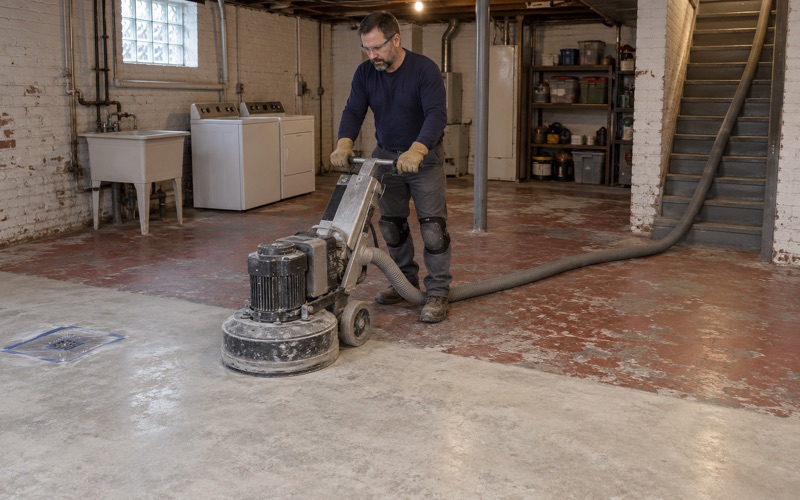
Every job starts the same way. We open the concrete with a diamond grinder or a shot blaster, never acid, and we put a moisture test into the written scope instead of offering one after a coating has already lifted. The proposal you sign names the product, the system build and the finished thickness, so anyone can hold the finished floor up against the paperwork.
We also look at the slab before we price it. If the cracks, an old coating or a failing patch mean the concrete has to be repaired or replaced first, we say so in plain words, and we read the warranty exclusions aloud before anything is sold, starting with moisture.
A Public Course on 95th Street and the Fleet It Runs
Hickory Hills is a Cook County city that counted 14,505 residents in 2020, sitting principally in Palos Township, and one of its most recognizable properties is Hickory Hills Country Club on 95th Street. It is a public course, not a members-only club, and it describes itself as founded in 1917. It runs an 18-hole Championship South Course and a 9-hole Executive course, keeps a golf cart fleet for course play, and hosts weddings, showers, church events, holiday parties and milestone celebrations in its clubhouse.
That combination matters for flooring. A venue like it carries two very different kinds of working floor under one operation: a vehicle floor on one side and a food-service floor on the other. We have not worked at the club and do not know where or how its carts are stored, so what follows describes the floors that this kind of operation needs, wherever in town they sit.
Where a cart fleet lives and charges
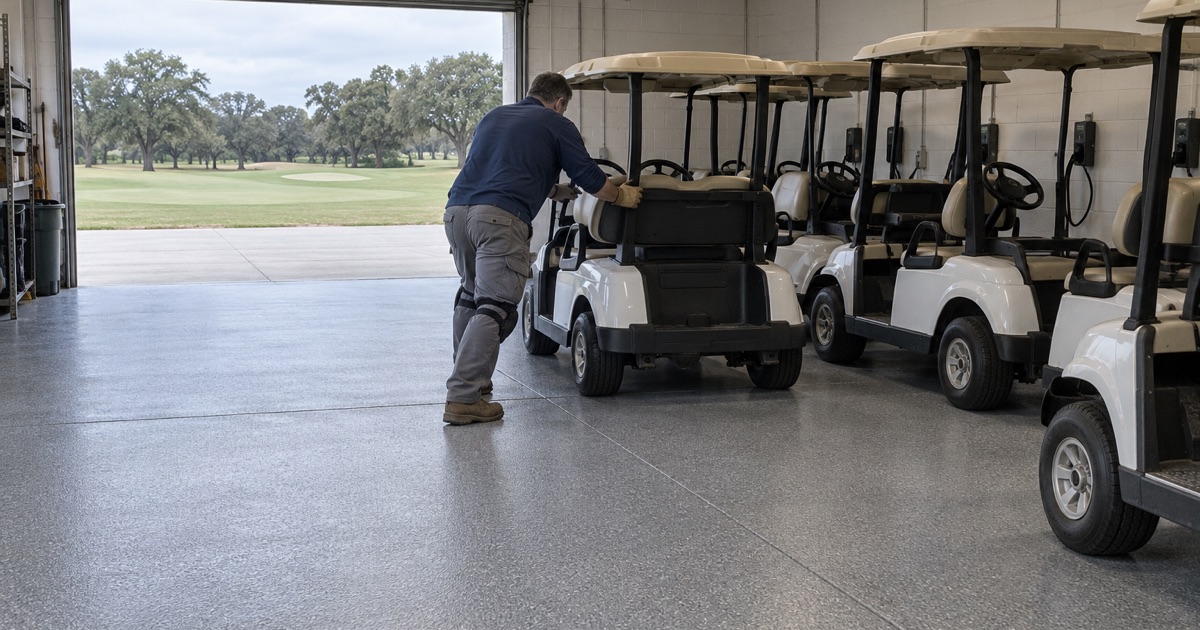
A golf cart floor sees tire traffic every day of the season and then holds a parked fleet through the winter. Wet tires bring in grass clippings, sand and fertilizer, and in the cold months they track in the calcium chloride brine and rock salt that every Cook County parking lot carries. A bare slab soaks that up, dusts under the wheels and stains around the parking rows.
Charging adds its own load. Battery service means occasional acid drips, water spills during topping off and steady foot traffic along the charger line. For that zone we usually look at a 100% solids epoxy base with a chemical-resistant topcoat, often polyaspartic or polyurea, and a quartz aggregate broadcast for grip where people walk on a wet floor.
Winter storage is a quieter test. A parked fleet leaves the same tire footprints on the slab for months, and slush melting off the last carts in can sit in a low spot until spring. We look for those low spots and the drain locations before we quote, because a coating cannot fix a floor that holds water.
Tire marks, wash-down and hot tire pickup
Cart tires are lighter than car tires, but they turn tightly in place, and that scuffing is what wears a thin coating through at the end of each row. Hot tire pickup, where softened rubber lifts a weak coating, is mostly a sign of poor preparation or a film too thin for the traffic. That is the reason we specify a measured build and a ground profile in the ICRI CSP range the primer calls for, rather than a roll-on paint.
Wash-down matters as well. A fleet floor that gets rinsed needs a surface that sheds water toward a drain, a texture that stays safe when wet and joints that are filled rather than left to collect grit.
Looking for epoxy-flooring closer to Norridge? See Norridge Epoxy-Flooring.
Banquet Kitchens and Serving Corridors
The other half of a venue like this is food service. A banquet operation runs a commercial kitchen behind the hall and serving corridors between the two, and those floors are judged by a health inspector as much as by the owner. In Hickory Hills, the public health authority is the Cook County Department of Public Health.
What a kitchen floor has to do
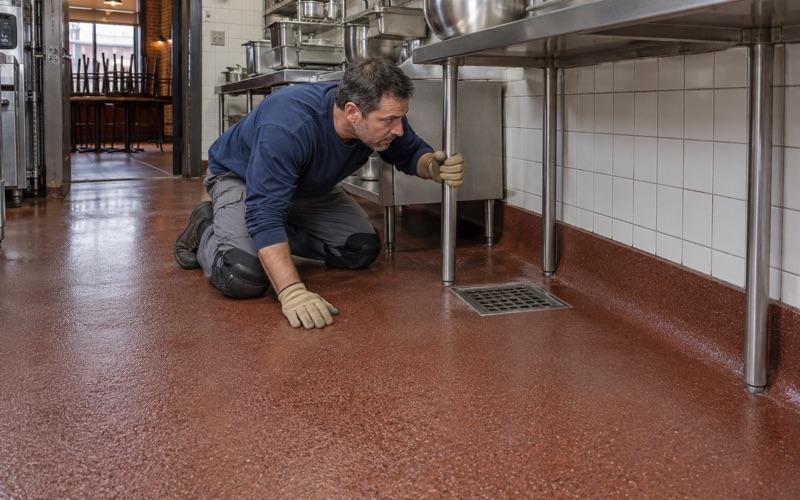
A kitchen floor has to be smooth, durable, nonabsorbent and easy to clean. The FDA Food Code allows a slip-resistant texture where safety calls for it, and it expects coved junctures where the floor meets the wall in areas that get water-flushed, so grime cannot settle in a corner. We build that cove into the system rather than caulking a gap afterward.
For kitchens that see hot water, grease and steam cleaning, urethane cement is often the better choice than standard epoxy, because it tolerates thermal shock and constant moisture. We explain that tradeoff in the proposal and name the system we would use, instead of quoting one product for every room.
Floor drains and trench drains are where we look first on a kitchen floor. We grind down to sound concrete around each drain body, carry the coating into the drain rim, and keep the slope intact so water does not pool where staff stand. Fresh epoxy in a cold, damp room can also develop amine blush, a greasy film that has to be washed off before the next coat will bond.
Serving corridors and the path from kitchen to hall
The corridor between the kitchen and the banquet room takes rolling carts, dropped trays and a steady line of staff during an event. A broadcast quartz floor with a sealed topcoat gives grip without the deep texture that traps food. Where the corridor opens into a finished hall, we plan the transition so the coating ends cleanly at the threshold.
Clubhouse Floors and a Year-Round Calendar
A clubhouse adds a third floor type: locker rooms, pro shop aisles and hallways that take golf spikes. Even soft spikes concentrate pressure on small points, and they pick at thin coatings and polished finishes alike. A broadcast system with a tough topcoat holds up better here than a smooth decorative floor, and it stays safer when shoes come in wet from the course.
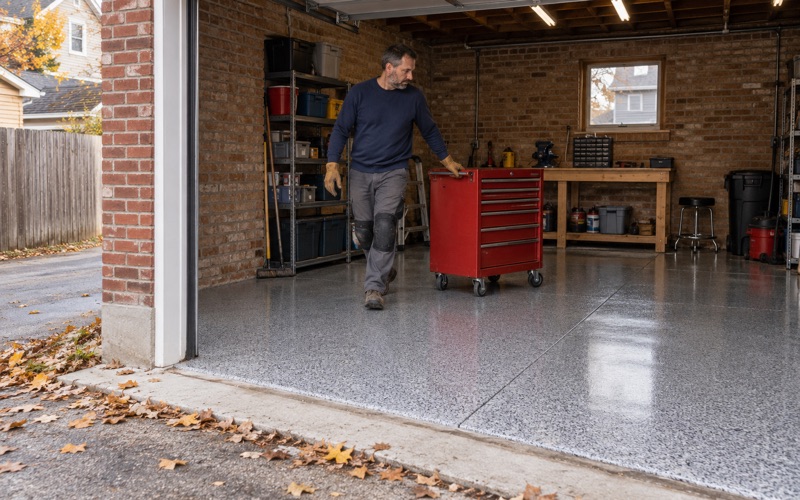
Pro shop and lobby floors are also on display. A vinyl flake broadcast in a venue’s colors can carry a finished look while keeping the grip and wear of a working floor, and a polyaspartic topcoat resists the yellowing that plain epoxy shows where sunlight comes through the doors.
Picking the window for the work
A course with a clubhouse that operates year-round never really closes, so floor work has to be scheduled around both the golf season and the event calendar. The off-season frees up a cart storage area, but winter also brings cold slabs. We schedule curing against slab temperature and dew point rather than a date on the calendar, and we will say when an unheated space has to wait for spring.
Kitchens and corridors run on a different clock. We plan commercial floors around the hours a building has to keep working, including overnight and weekend windows, and we sequence a job in sections when a venue cannot shut its kitchen and its hall at the same time.
Moisture and the coating we choose
Any slab on grade can carry moisture, and a floor that is washed down daily gets a lot of it from above as well. We test with ASTM F2170 in-situ relative humidity probes or ASTM F1869 calcium chloride tests, depending on the slab, and when readings run high we use a moisture-mitigation primer instead of hoping the coating copes. Every product we use stays inside the Illinois VOC limits for architectural coatings, which bind the installer as well as the manufacturer.
Homes, Garages and the City of Hickory Hills License
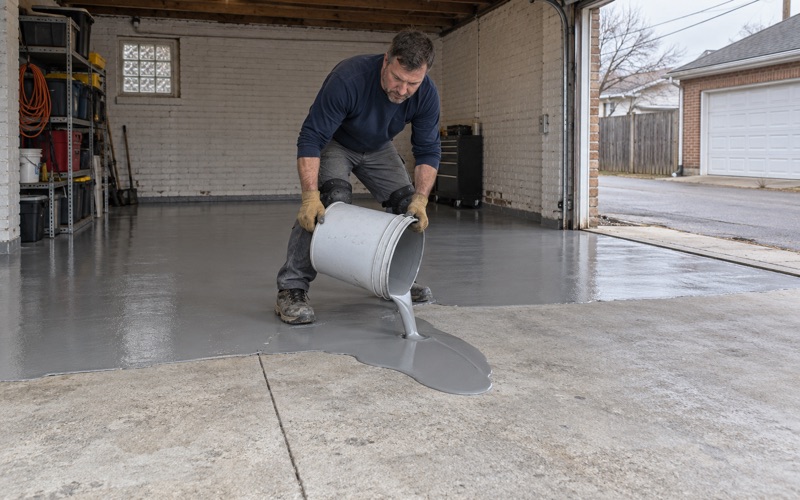
Home floors are the other half of our work in Hickory Hills. The city is mostly owner-occupied detached houses, and their garages take the same salt brine every winter that a parking lot does. We build garage floors for that, with a ground profile, a full-solids base and a topcoat chosen for chemical resistance rather than shine.
A garage slab that has to face salt
Before we coat a garage, we run moisture testing on it the same way we would a basement, with an ASTM D4263 plastic sheet test as a first read and probes where the result calls for more. A slab that pushes vapor will lift any coating, however good the product. When the slab is dry and sound, a flake broadcast floor with a polyaspartic topcoat gives a surface that rinses clean of salt residue in spring.
What the city asks of every contractor
Illinois issues no state license for flooring or coatings work, so the City of Hickory Hills license is the one that binds. Every contractor working in the city holds a city contractor license, which runs on the calendar year from January 1 to December 31 with no half-year option. The application has to include a certificate of insurance naming the city as certificate holder, and a copy has to reach the homeowner or business owner before work begins.
Unlike some nearby towns, Hickory Hills requires no bond. The city’s hauler also does not take contractor debris, so we carry out our own grinding dust and old coating, and we collect that dust on site instead of washing it toward a drain. The Building Department sits on 95th Street, and we confirm the current requirements with it before a job goes on the schedule.
Paperwork for a home job
For residential work, the Illinois Home Repair and Remodeling Act requires a written contract and the Home Repair: Know Your Consumer Rights pamphlet before work starts, and we provide both every time. We also do not sell a floor coating as a radon fix, because radon mitigation in Illinois takes a separate state license.
Whether the floor holds a row of charging carts, a banquet kitchen or a two-car garage, we read the slab first, write down exactly what we will install, and schedule the work around the people who still need the space.
- 20+ Years Coating Floors
- Moisture Tested Before Quoting
- Free Written Estimates