Berwyn Epoxy Flooring brings more than 20 years of slab preparation and resin work to epoxy flooring in Franklin Park, and some of the most demanding floors we price here sit in buildings where the equipment matters more than the foot traffic. A support room beside a technical space asks different questions than a garage does. The coating has to stay put, shed nothing into the air and hold a spill where it lands.
We start every one of those conversations the same way. The slab gets opened mechanically with a diamond grinder or a shot blaster, never acid etched, and moisture testing is written into the scope as its own line rather than offered after a failure. The proposal then names the product, the system build and the finished thickness, so a facility manager can check what went down against what was quoted.
That paperwork matters most where a floor sits inside somebody else’s specification. When an owner or engineer hands us requirements, we build to them. When nobody has written any, we ask the questions below before we recommend a system.
Grand Avenue’s Data Center Campus and Concrete Dust
What sits on Grand Avenue
Franklin Park is a village in Leyden Township, Cook County, and its Grand Avenue corridor holds the Digital Franklin Park campus that Digital Realty describes as 40 acres. The company’s own listing for ORD13 puts it at 9355 Grand Avenue, at 224,500 square feet with N+1 UPS redundancy. Digital Realty first bought in the village in 2012, and on January 25, 2017 the village and the company held a demolition day at the former Motorola headquarters at 9401 Grand Avenue.
We mention the campus as a landmark, not a client. We have not read Digital Realty’s floor specification, and nothing here describes their floors. What the campus does show is that Franklin Park’s floor market includes mission-critical support space, and the owners and contractors who build and serve that kind of space ask us questions a homeowner never would.
Why concrete dust matters where servers breathe
Bare concrete dusts. Foot traffic, carts and pallet jacks wear the weak top layer of a troweled slab into a fine powder, and in a room that feeds air to sensitive equipment, that powder goes wherever the air goes. Sealing the slab is usually the first thing a support-space owner wants from us, ahead of looks or color.
There are two honest ways to get there. A lithium silicate densifier hardens the surface and cuts dusting without adding a film, which suits a room that only needs the powder stopped. A 100% solids epoxy system puts a continuous, cleanable skin over the concrete, and it is the choice when the room also needs chemical resistance or a defined finish.
Our own dust comes first
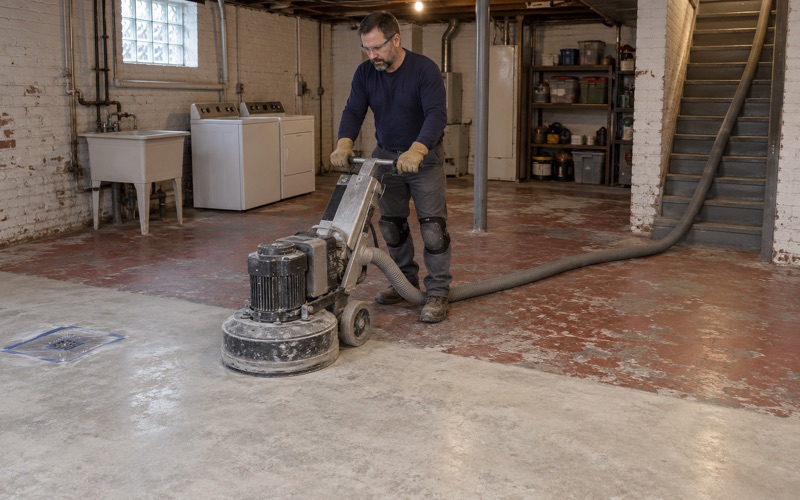
Preparing a slab makes dust of its own, which is the irony of this work. Our grinders and shot blasters run with vacuum collection, the dust is bagged and carried out, and none of it is washed toward a drain. In an occupied technical building we also ask the facility team how they want adjacent rooms sealed off and which air handlers should be watched while we grind.
Looking for epoxy-flooring closer to Hickory Hills? See Epoxy-Flooring Services in Hickory Hills.
Battery and UPS Rooms: Containment Underfoot
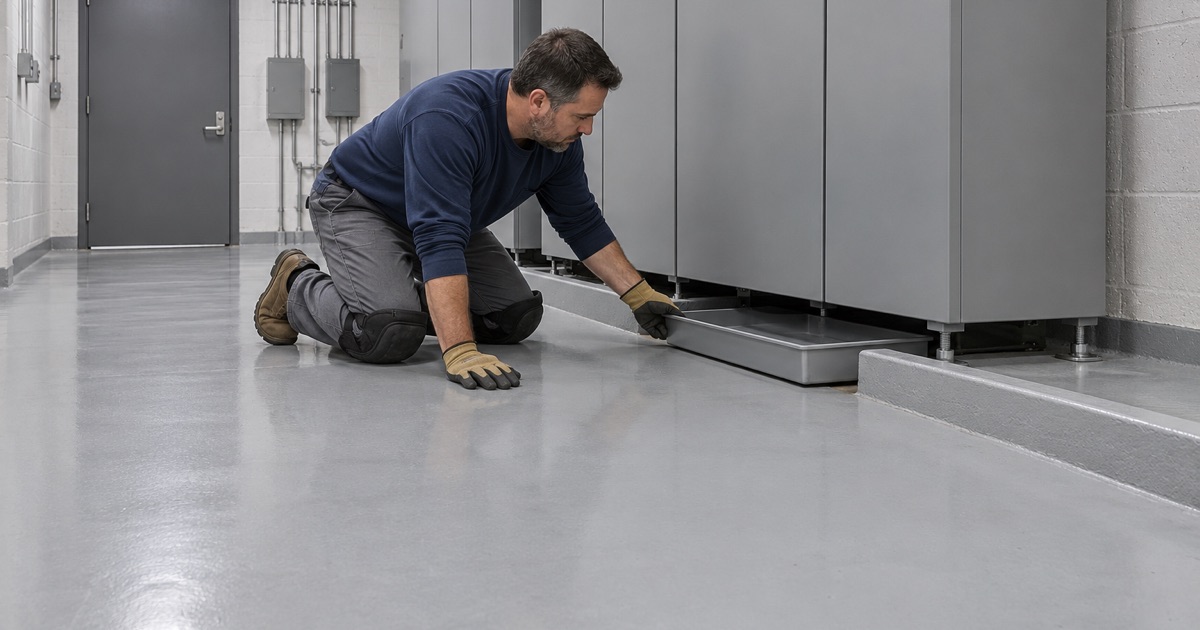
UPS and battery rooms are where a floor coating earns its keep in a mission-critical building. Batteries can leak electrolyte, and the floor beneath a battery rack is the last barrier between that spill and the bare slab. Uncoated concrete absorbs what lands on it, while a properly built resin floor keeps it on the surface long enough to be found and cleaned.
Matching the coating to the chemistry
Battery chemistry decides the system. A flooded lead-acid room calls for a coating rated for acid contact, while a room of sealed or lithium cabinets may need far less chemical resistance and more attention to abrasion from cabinet moves. We ask for the battery type and the owner’s spill plan before we name a product, and the proposal says which exposure the system was chosen for.
Edges, curbs and cove
Containment fails at the edges first. Where the owner wants a spill held in the room, we can run the coating up the wall as an integral cove, so there is no open joint where floor meets wall for a liquid to find. Curbs, trench edges and the bases of equipment pads get the same treatment, because a spill follows the lowest seam it can reach.
What the slab says before we coat it
A battery room floor carries heavy, concentrated racks, so we read the cracks and any old coating before quoting. If a crack is moving or a previous coating is letting go, we say so and recommend repair first, because a new film over an unsound slab only hides the problem until a rack shifts. Moisture is tested here too, with ASTM F2170 in-situ relative humidity probes or ASTM F1869 calcium chloride testing, since vapor pushing up under a sealed floor is a leading cause of blistering.
Profile comes next. Resin in a containment room has to bond, not just sit on top, so we grind or blast to the ICRI concrete surface profile the system calls for and remove old sealers that would otherwise break that bond. Where moisture readings run high, a moisture-mitigation primer goes down before the build coat rather than hoping the floor tolerates it.
Static-Dissipative or Not: The Owner’s Spec Comes First
Static control is the question we hear most from technical-floor owners, and it is the one we are most careful not to answer for them. We have not read any code or standard that requires a static-dissipative or epoxy floor in a data center, so we do not sell one as a requirement. Whether a room needs it is a decision for the owner, the equipment maker or the engineer of record.
Dissipative, conductive and plain
Static-dissipative and conductive ESD floors are built to land inside a stated electrical resistance range, usually with conductive primers and grounding points tied into the building. A plain epoxy floor is not one of them and should never be described as one. If the specification names a range, the proposal names the system that meets it and how the finished floor will be tested.
Testing matters because an ESD floor can drift out of range if it is waxed, coated over or cleaned with the wrong product. We tell owners which cleaners the system tolerates and ask who will run the periodic resistance checks after we leave.
Support space versus the data hall
Our work in this kind of building is the slab-on-grade support space: UPS and battery rooms, loading and staging areas, mechanical rooms and corridors. The server halls themselves, built on elevated panel systems, are outside our scope, and we say that at the first walkthrough so nobody plans around work we do not carry. Where a support room meets a hall, we coordinate the transition with whoever owns the hall floor.
Topcoats and traffic
Loading and staging areas take the wheels and pallets, so they are usually where a harder-wearing finish earns its cost. A polyaspartic or polyurea topcoat over an epoxy base adds abrasion resistance, and a quartz aggregate broadcast gives texture where a wet dock floor would otherwise turn slick. Mechanical rooms with glycol and oil around pumps get a chemical-resistant topcoat chosen for those fluids.
Floor Work in a Building That Never Shuts Off
A building with N+1 UPS redundancy is designed so the load never drops, and the floor contractor has to work inside that promise. We schedule around the hours and the rooms the facility team can release, including overnight and weekend windows, and we plan each phase so one area is finished and open before the next is closed.
Phasing a room that cannot empty
Some battery and UPS rooms cannot be cleared at all. In those cases we talk with the owner about coating the open floor in sections, moving cabinets or racks only where their own team allows it, and leaving the footprint under fixed equipment for a planned outage. We would rather write a two-stage scope than promise a whole-room floor in a weekend that the equipment schedule cannot give us.
Odor, VOCs and the air handlers
Curing resin gives off odor, and in a building that moves air between rooms that matters. We choose floor coatings within the Illinois limit on VOC content, a rule that binds the installer as well as the manufacturer, and a low-odor 100% solids epoxy or a fast-cure polyaspartic often suits an occupied building best. Before we open a can, we agree with the facility team on ventilation and on which intakes need watching.
Cure by the slab, not the clock
A tight outage window tempts everyone to rush the cure. We schedule curing against slab temperature and the dew point spread at the slab surface, because resin laid on a cold, damp slab can develop amine blush or stay soft underneath. A loading area near an overhead door in winter may need temporary heat or a later date, and we say that plainly when the numbers are not there.
Beyond the campus
The questions on this page are not limited to the campus. Telecom closets, equipment rooms and server rooms in office and warehouse buildings across Franklin Park face the same three issues of dust, spills and static on a smaller scale. We bring the same testing, the same written proposal and the same respect for the hours a room has to stay live.
Warranty terms read out first
Before any technical-space job is sold, we read the warranty exclusions out loud, and moisture is the first one named. A floor sealed over a slab with high vapor emission can blister no matter how well it was installed, which is why the test results sit in the proposal next to the system we recommend. The owner signs off knowing what the floor is built to handle and what falls outside it.
When the walkthrough is done, a Franklin Park facility team gets a written scope it can hand to its own engineer: test method and results, surface preparation, the product and build, the finished thickness, the work windows and the exclusions. If the right answer is a densifier instead of a coating, or a slab repair before anything else, that is what the scope will say.
- 20+ Years Coating Floors
- Moisture Tested Before Quoting
- Free Written Estimates