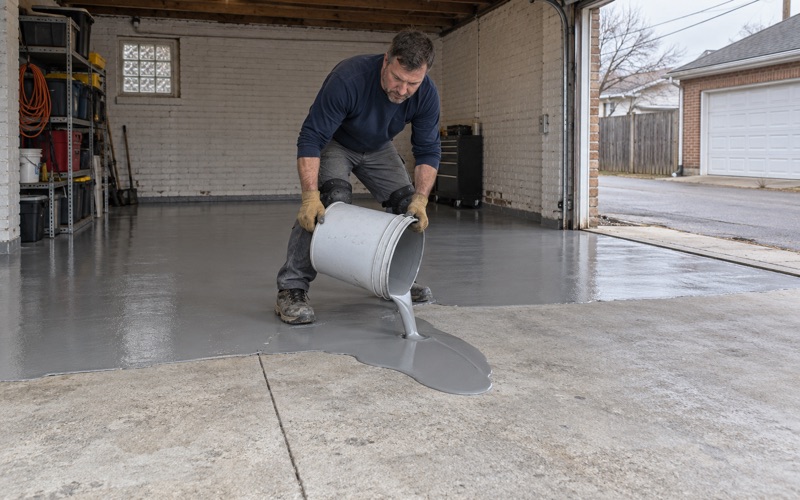
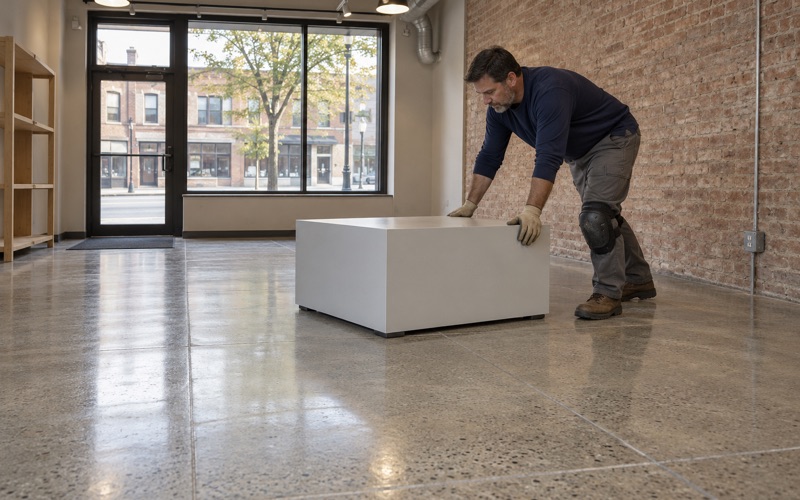
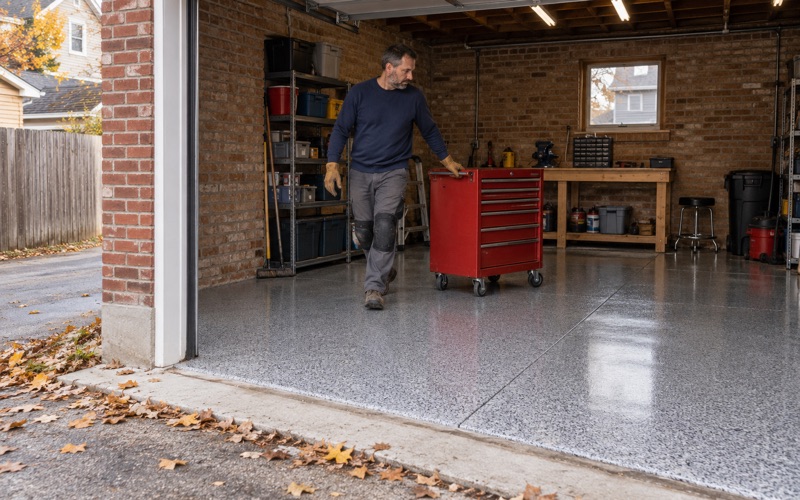
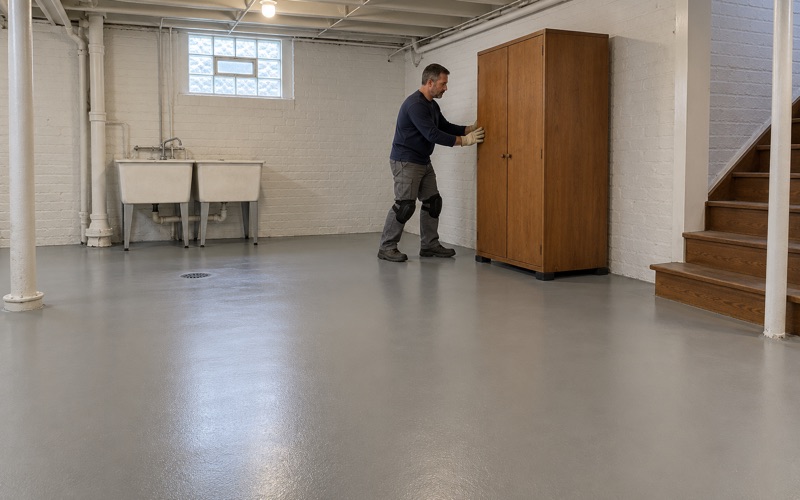
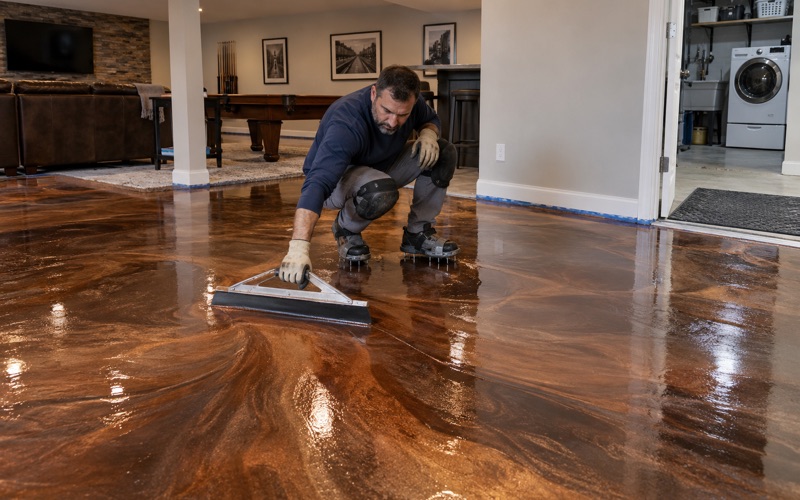
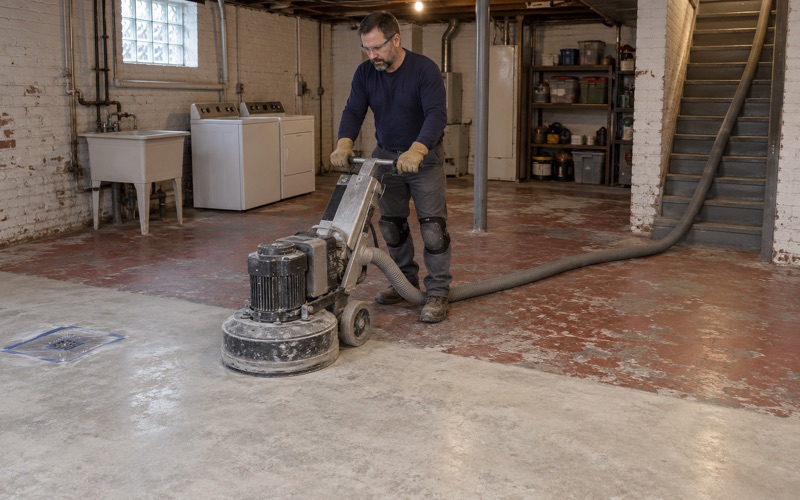
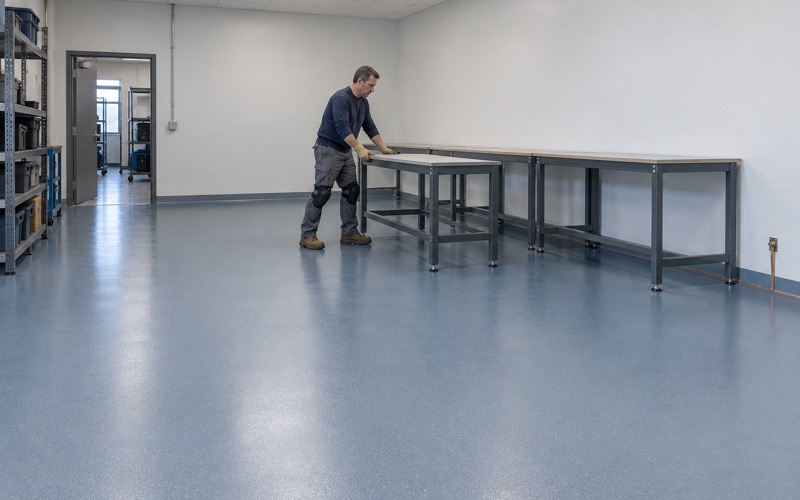
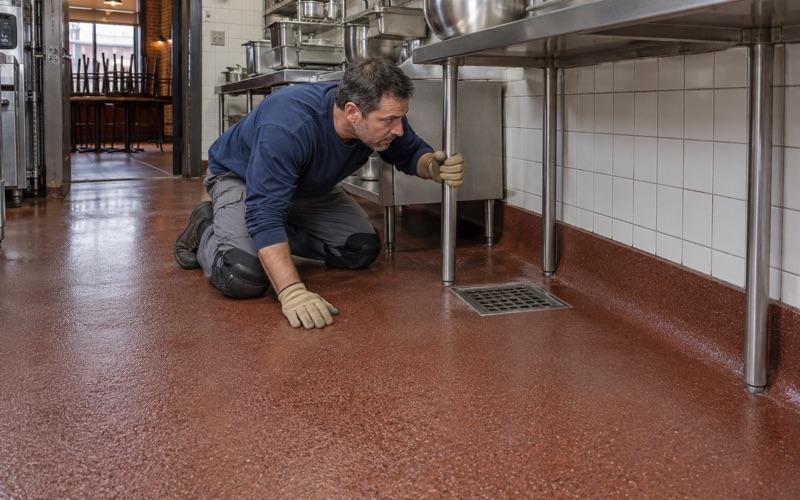
Berwyn Epoxy Flooring brings more than 20 years of epoxy-flooring in Forest Park and across this corner of Cook County to garages, basements and working commercial floors. Whatever the room, the job starts the same way: the slab is opened mechanically with a diamond grinder or a shot blaster, and we do not acid etch, because a coating can only hold as well as the concrete surface it grips.
We price from what the floor shows us, not from a square-foot chart. Cracks, old coatings and moisture are read before the quote, and when a slab needs repair or replacement first, we say so. The written proposal then names the product, the system build and the finished thickness, so what you were sold can be checked against what went down.
Further down, this page uses one unusual building in the village as a teaching case. A floor that handles railcars, wash water and lubricants every day shows, in exaggerated form, exactly what a home garage or small shop floor has to survive.
A Railcar Shop Among the Houses and Two-Flats
Desplaines Yard and Shops
CTA’s Desplaines Yard and Shops sits beside the Eisenhower Expressway at Desplaines Avenue, and the yard’s mapped point falls inside Forest Park village, in Proviso Township. The yard dates to 1959. Rail historians at Chicago-L.org put its capacity at 122 cars, not counting the loop, shop and lead tracks.
Next door is the Forest Park terminal, the western end of the Blue Line. The CTA’s Forest Park Branch Rebuild works on the line nearer downtown: its $268 million Phase I, from 2023, rebuilds about 15,000 feet of track between LaSalle and Illinois Medical District, and the whole branch is estimated at about $3 billion. That published scope does not name the Desplaines yard or shop.
Twelve Cars, Three Tracks, Hoists and a Washer
According to the Chicago-L.org history, the inspection shop was built between April 1961 and July 1962. It covers about 26,000 square feet, with room for 12 cars on three maintenance tracks. Hoists lift paired cars so crews can reach the undercarriage, and an automatic train washer lets an entire train run through the building.
The 1960s tan-brick shop is still in use. That combination is what makes it worth studying: water from the washer, metal grit from wheels and brakes, and oil from the undercarriage can all reach one floor, under cars lifted overhead.
Our Place in This Story
To be plain about it, the CTA is not our customer, and we have not seen, tested or quoted the floor in that building. We use the shop as a reference because its loads are the loads of any working garage, turned up several notches.
The yard sits in a village of houses, two-flats and apartment buildings. The floors in those buildings face the same forces at a fraction of the scale, which is the thread running through the rest of this page.
Looking for epoxy-flooring closer to Lyons? See Epoxy-Flooring Services in Lyons.
What Wash Water, Brake Dust and Oil Do to Concrete
Each of the three contaminants attacks a floor coating differently, and a system that answers one can lose to another. Here is how we think through each when we spec a floor that sees them.
Standing and Splashed Water
Water by itself rarely ruins a well-bonded coating. The damage comes when it finds a way underneath: a hairline crack left unfilled, an edge that was never keyed in, a thin film that pinholed during cure. Once water sits beneath a coating, it spreads the disbond outward every time the floor is washed. In any wash bay that cycle repeats with every wash; in a garage it repeats each time a wet car pulls in.
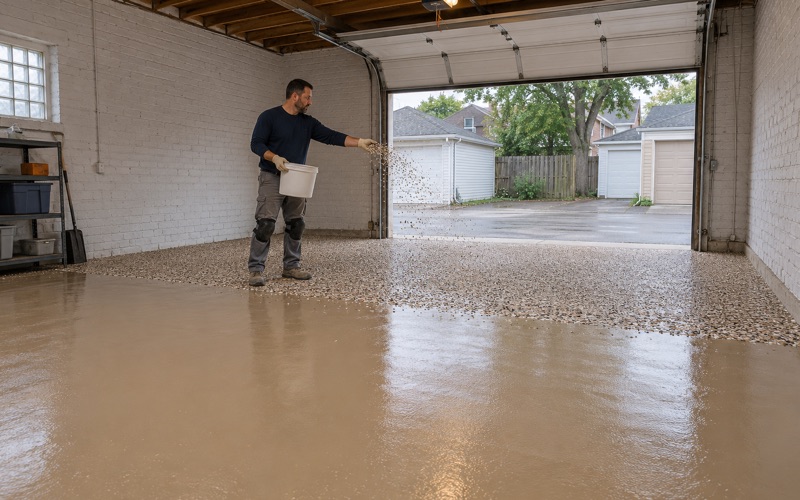
For wet floors we lean toward a 100% solids epoxy base, built thick enough to bridge minor surface defects, with a quartz aggregate broadcast so the surface keeps its grip when wet. Where floor meets wall, a cove keeps water from sitting in the joint.
Brake Dust and Abrasive Grit
Brake dust and wheel wear shed fine, hard particles. Underfoot, under carts and under rolling equipment, that grit behaves like sandpaper, and a soft or thin topcoat dulls and wears through in the traffic lanes first.
Where abrasion is the main threat, we reach for polyaspartic or polyurea topcoats over the epoxy build, and a broadcast of quartz or vinyl flake gives the wear surface some body. The proposal states which topcoat and how many coats, so the wear layer is something you can verify.
Lubricants Soaked Into the Slab
Oil and grease are the quiet problem. Bare concrete absorbs them, and a coating applied over an oil-soaked slab can look fine for a season before it lets go in exactly the spots where drips collected.
Grinding or shot blasting to a measured ICRI CSP surface profile removes the stained skin, and deeper contamination has to be cleaned out or cut out before primer goes down. Where heat, hot water and chemicals all arrive together, urethane cement is often the better answer than epoxy, and we will say so in the quote.
Why the Mix Matters
A floor that sees all three at once needs a system chosen for the worst of them, then checked against the others. A thick epoxy that resists water can still scuff under grit, and a hard topcoat that resists grit can still lift if oil was left in the slab underneath.
Pits, Rails and Drains: Where Floors Fail First
On almost any working floor, a coating fails at its edges long before it fails in the open field. Every place the film stops or changes direction concentrates stress, and a shop floor is full of them.
Pit Edges and Embedded Rail
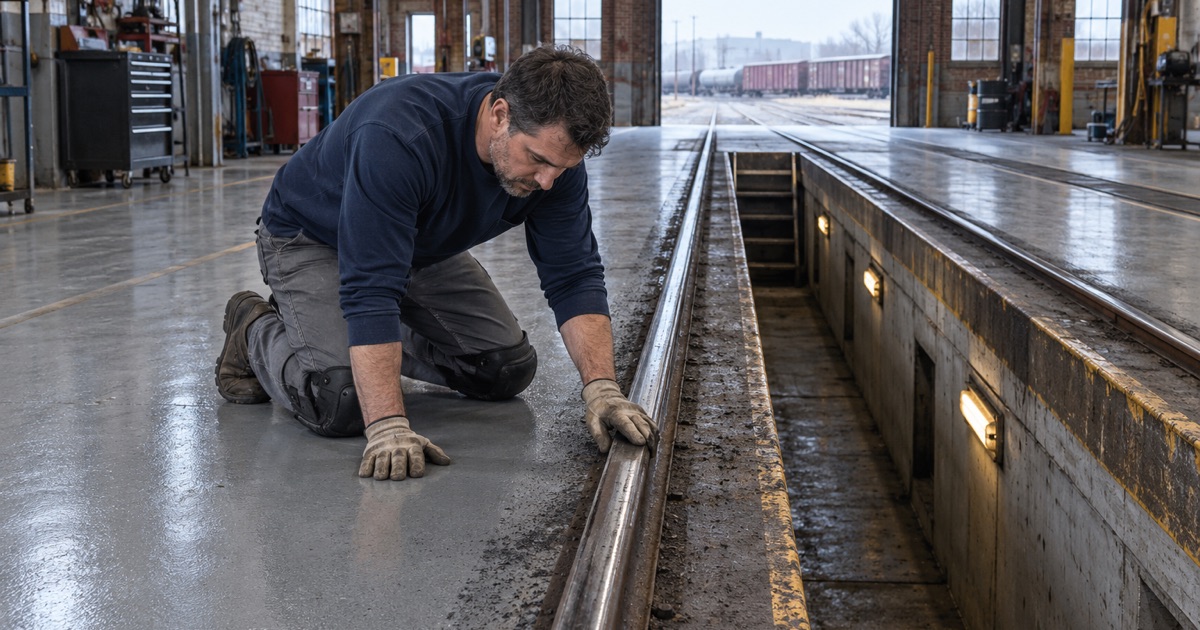
In a railcar shop, steel wheels roll on track set into the slab, and inspection pits break the floor into strips. Each rail edge and pit lip is a line where the coating ends against steel or a vertical face, under heavy point loads.
We handle terminations the same way at any scale. A saw-cut groove at the edge gives the coating something to lock into, so traffic catches a buried shoulder instead of a feathered lip that peels. In a home garage, the same detail goes at the overhead door, the step to the house and around any slab joint.
Drains and Cracks
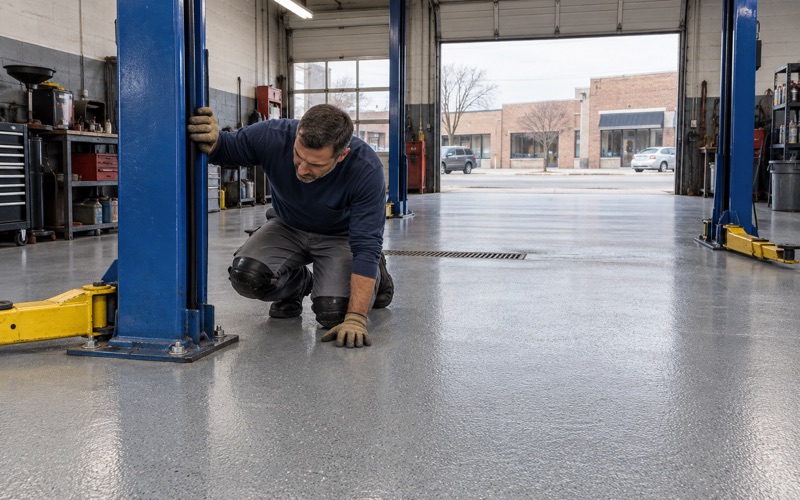
Drains are where water and grit concentrate, so the coating has to be detailed into the drain body rather than stopped short of it. In a garage, the same thinking applies to a floor drain or a trench at the door: the finish should carry water to it, not pond against a lip left behind.
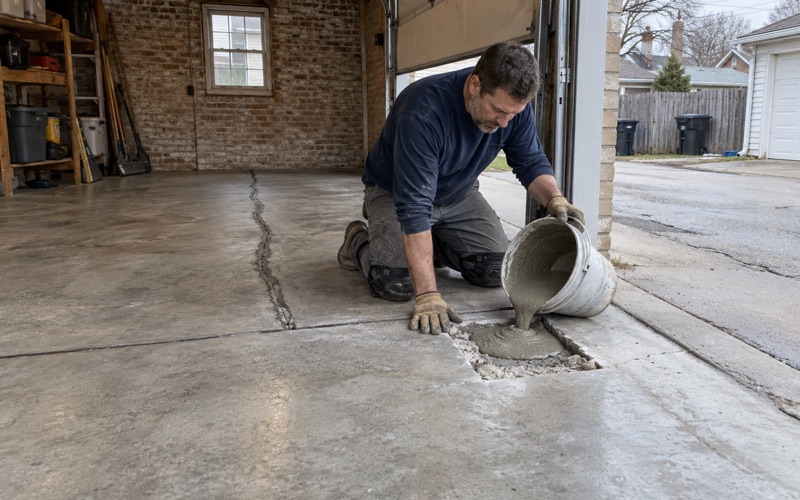
Cracks get read before anything else: a dormant hairline can be filled and coated over, but a crack that is still moving will telegraph through any resin. When a slab is broken, heaved or settling, a coating only hides the problem for a while, and the proposal will show the repair as its own line.
Floors That Cannot Close
Commercial and shop floors usually have to keep running. We schedule those jobs around the hours the building operates, including overnight and weekend windows.
Cure is planned against slab temperature and the dew point spread at the surface, not the calendar. A coating that goes down onto a slab near its dew point can blush or fail to bond, and amine blush left on an epoxy coat weakens the next layer. For an unheated detached garage, that sometimes means telling you the job has to wait for spring.
From the Rail Shop to Your Garage
Shrink the shop down to one car and most of the same forces are still there. Tires carry in water and grit, engines drip oil, and hot tires parked on a poorly bonded coating can cause hot tire pickup, where the tread lifts a weak topcoat right off the floor.
The residential code, at IRC R506.2.3, lets a garage slab be poured without the vapor retarder required under living space, so a garage that has never shown a damp spot can still push moisture into a new coating. Dry-looking concrete is not the same as a dry slab.
A Village of Older Slabs
Forest Park’s housing is old. Of 7,649 housing units, 3,653 were built in 1939 or earlier, and another 1,366 went up in the 1960s. A prewar basement slab and a 1960s garage slab behave differently, and neither one comes with a record of what was poured beneath it.
That is why moisture testing is a line item in our scope rather than an upsell after a floor blisters. Depending on the slab, that means an ASTM F1869 calcium chloride test, ASTM F2170 in-situ relative humidity probes, or a first look with the ASTM D4263 plastic sheet test, and a moisture-mitigation primer where the numbers call for one.
Older basements also carry history on the surface. Before choosing a system we check for paint, patches and old adhesive, since a prewar floor may hold decades of layers that have to be dealt with. Warranty exclusions are read to you before the job is sold, and moisture is the first one we name.
Alley Garages and Shared Buildings
Where a detached garage opens onto an alley, that is where we stage the job. Grinding dust is collected on site and is never washed toward a drain. In a two-flat or rental building, we set the schedule with the owner and work around the tenants who still need the garage or basement.
Paperwork Before the Grinder Starts
Illinois issues no state license for flooring or coatings work, so we confirm what the Village of Forest Park requires for contractor licensing, bonding and insurance before a job goes on the calendar. Every home job also gets a written contract and the Home Repair: Know Your Consumer Rights pamphlet before work begins, as the Illinois Home Repair and Remodeling Act requires.
The coatings themselves are chosen within the Illinois VOC limits for architectural coatings, which bind the installer as well as the manufacturer. It is a rule about the product in the can, and it is ours to follow, not just the supplier’s. We also do not sell a floor coating as radon reduction; in Illinois that work takes a state radon mitigation license from IEMA.
- 20+ Years Coating Floors
- Moisture Tested Before Quoting
- Free Written Estimates