Berwyn Epoxy Flooring brings more than 20 years of epoxy flooring work to Brookfield homes, garages and basements, and on every job here the first thing we settle is the scope. A coating laid over a sound concrete slab is one kind of project. A coating that follows new drain tile, a moved floor drain or a newly finished basement room is a different project, with a permit and an inspection attached to it.
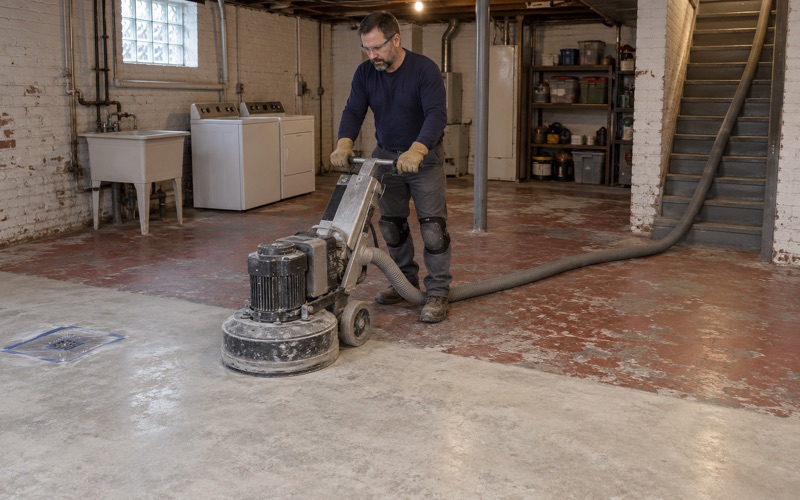
That is why our proposals are written the way they are. Each one names the product, the system build and the finished thickness, and moisture testing appears as its own line rather than as an add-on sold after a floor has already blistered. Every slab is opened with a diamond grinder or a shot blaster, and we never acid etch.
A written scope that specific is easy for you to check against the finished floor. It also makes plain, before anyone orders material, which parts of the job sit on the permit-free side of the line and which parts do not.
What Brookfield Lists as Permit-Free, and Where a Floor Job Crosses Over
The Village of Brookfield publishes its own Building and Permitting page, and it draws a fairly clear line through the kind of work we do. Reading it with you before a job is scheduled saves a surprise later.
The no-permit list
The village lists painting, tile work, driveway sealcoating and “replace existing flooring” as work that does not need a permit. A coating applied to an existing garage or basement slab looks a lot like replacing existing flooring, and that is how we would read it.
That reading is our inference, not a ruling. The village page does not mention epoxy or floor coatings by name, so on any job where it matters we suggest a quick question to Building and Planning before work starts. It costs a phone call or an email and removes the guesswork.
Drain tile and foundation waterproofing
The same page lists installing interior or exterior drain tile, and foundation waterproofing, as work that does need a permit. This is where a basement floor job most often changes category.
A floor coating does not keep water out of a basement and it is not a substitute for drain tile. When our moisture testing, whether an ASTM F1869 calcium chloride test or ASTM F2170 in-situ relative humidity probes, shows a slab that is carrying more vapor than a coating can tolerate, we say so. If the answer is drain tile or waterproofing, that permitted work comes first, done by the trade that installs it, and the coating follows once the slab has been retested.
Finishing a basement room or moving plumbing
Finishing a room in a basement is on the village’s permit list, and so is any alteration to an interior plumbing system. A coating that is one step inside a larger basement finish rides along with that project rather than standing alone.
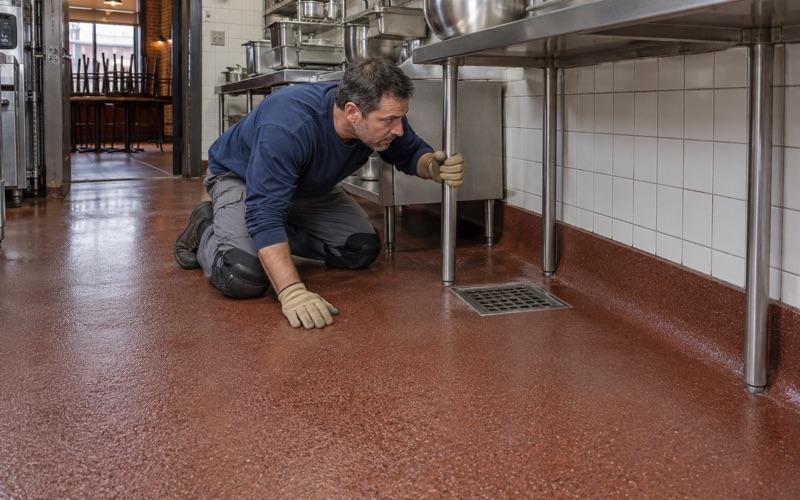
The plumbing item catches people more often. Moving a floor drain, regrading around a sump pit or reworking the drain line under a laundry area are plumbing changes, and they belong in the plumbing scope with its own permit. We detail the coating around the floor drain and sump pit as they are, or as the plumber leaves them.
Looking for epoxy-flooring closer to River Forest? See Epoxy-Flooring in River Forest.
Coat the Slab, or Replace It: Two Different Answers at Village Hall
Most of the floors we see in Brookfield can be coated. Some cannot, and the difference between the two is also the difference between a permit-free job and one that goes through the village.
An existing garage slab in sound condition
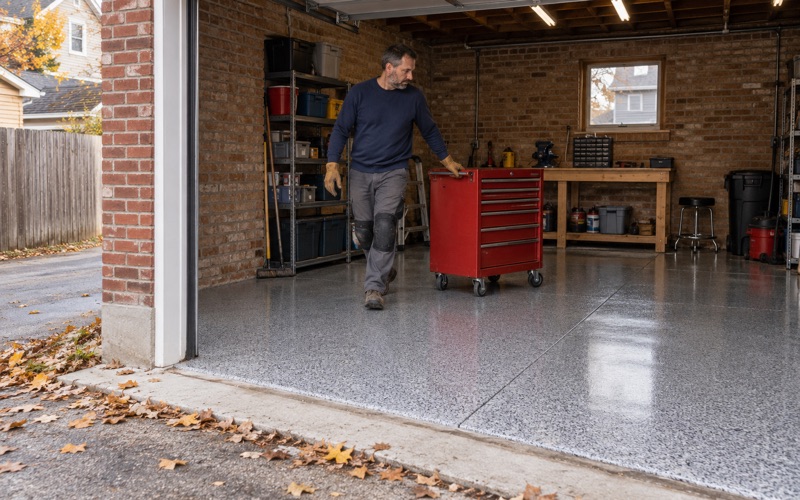
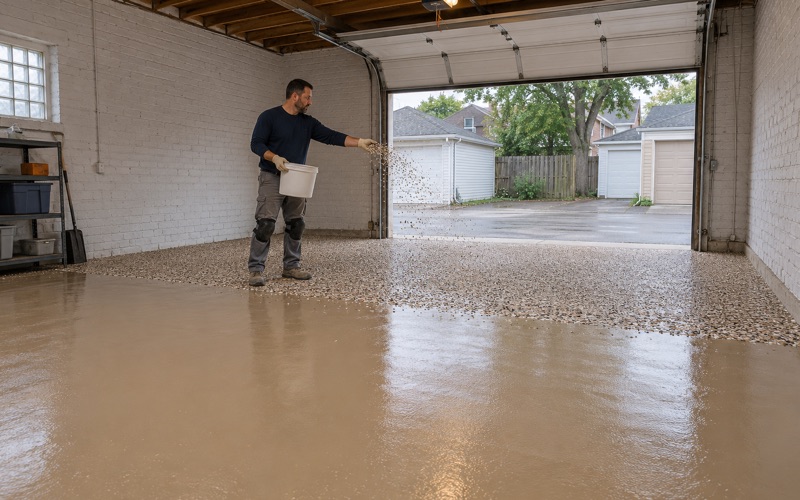
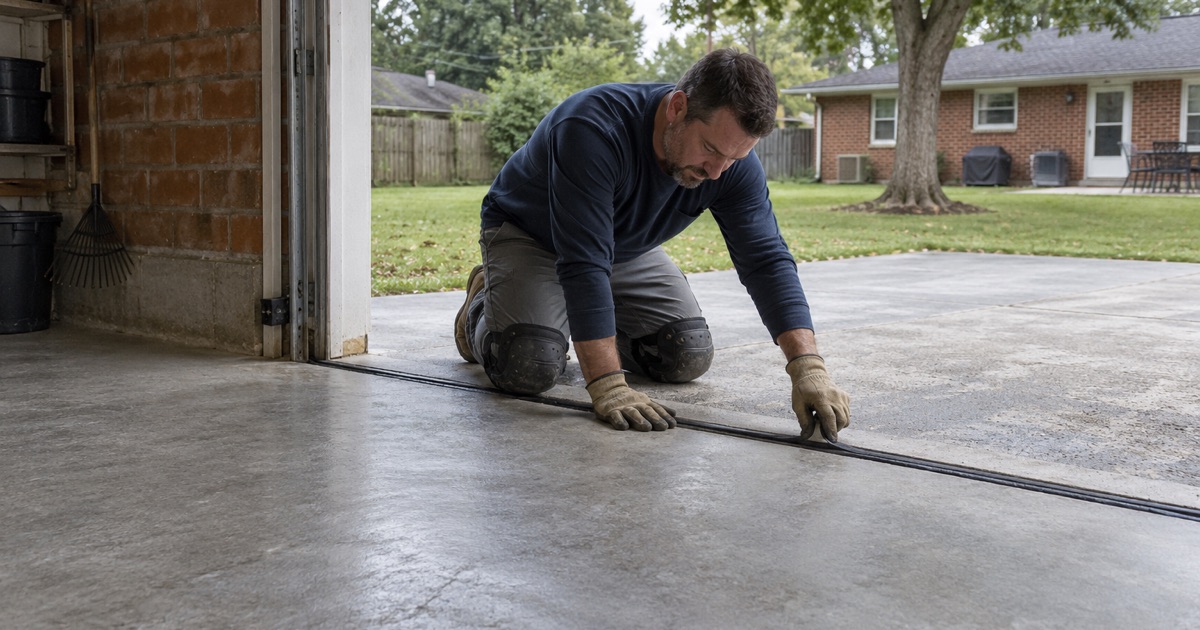
When a garage slab is intact, the work is surface preparation and a coating system. We grind to an ICRI concrete surface profile that suits the product, repair cracks and spalls, and build the floor in layers, often a 100% solids epoxy base with a vinyl flake broadcast and a polyaspartic topcoat.
That build is chosen for hot tire pickup and for the brine and grit a car tracks in, and the coating is selected within the Illinois limit on VOC content, which binds the installer as well as the manufacturer. None of it changes the size, shape or structure of the garage.
When the slab has to come out first
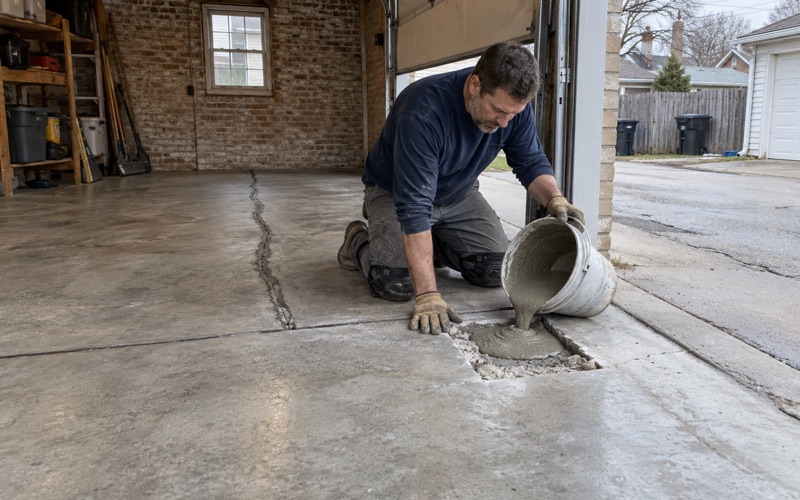
We read the cracks and the old coating before we quote, and some slabs are past saving. Heaved sections, wide cracks that keep moving or a slab broken into separate pieces need repair or replacement before any coating goes down, and we say that plainly rather than selling a floor that will fail.
Replacing a garage slab, or adding, altering or enlarging a garage, is permit work in Brookfield, and so is adding, repairing or replacing a driveway. That concrete work is a separate contract with its own permit. A new slab also needs time to cure and a moisture check before we come back to coat it, and we ask whether an under-slab vapor retarder meeting ASTM E1745 went in, since a garage slab is often poured without one under the IRC R506.2.3 exception.
Older basement floors and their layers
Brookfield’s housing runs old: 2,543 of its 7,927 housing units were built in 1939 or earlier. A basement slab that old may carry decades of paint, patching compound and flooring adhesive, and each layer changes what a coating will bond to.
How those layers come off depends on what they are. A thin, well-bonded paint film comes away in the grinding pass that profiles the slab, while a thick, flaking or soft layer needs a shot blaster or a heavier grind to reach sound concrete, and we tell you which your floor needs before the quote is signed.
We test and identify those layers before choosing a system, and we never coat over them. Removing an old finish and coating the bare slab still reads as surface work, not as the drain tile or finish carpentry that sends a project through Building and Planning.
Who Can Pull the Permit: The Village Contractor License
When part of a Brookfield floor project does need a permit, the village wants to know who is doing the work. Every contractor working in the village needs a Village of Brookfield Contractor License, with fees typically around $150, and a $10,000 License and Permit Bond.
A requirement, not a credential
Illinois issues no state license for flooring or coating work, so the town’s own contractor rules are the ones that apply. Before we put a Brookfield job on the calendar, we confirm the village’s current license, bond and insurance requirements for the work in question.
That registration is a condition of working in the village, the same for every trade, and it says nothing about the quality of a floor. We treat it as paperwork to have in order, not as something to advertise.
Who files for which part
On a mixed project, each trade usually files for its own scope. A waterproofing contractor handles the drain tile permit, a plumber handles the floor drain change, and the general contractor on a basement finish carries that permit. Where the coating is the only work, and it stays on the replace-existing-flooring side of the line, there may be nothing to file at all.
The village accepts permit applications by email at permits@brookfieldil.gov. Its building code, Chapter 12 of the municipal code, was most recently updated on April 10, 2023 to the 2021 International Building Code family, so permit questions are answered against those current editions.
The paperwork on a home job
Whatever the village requires, every home job we take gets a written contract and the Home Repair: Know Your Consumer Rights pamphlet before work starts, as the Illinois Home Repair and Remodeling Act requires. We also read the warranty exclusions out before the job is sold, with moisture named first, so nothing about coverage comes as news after the floor is down.
Scheduling Around Inspections in a Brookfield Spring
An inspection turns a floor job into a sequence, and the sequence sets the calendar. When drain tile, a slab replacement or a plumbing change comes before the coating, our start date depends on that work passing its inspection.
Notice the village asks for
Brookfield asks for a minimum of 24 hours’ notice to schedule an inspection, and it advises allowing two to three days in late March, early April and through the summer. We build that lead time into the plan instead of assuming a next-day inspection.
In practice that means a spring basement project with new drain tile can have a gap of several days between the waterproofer finishing and our crew arriving. We use the time to retest the slab once the permitted work is signed off.
Curing against the slab, not the calendar
Even without an inspection, spring timing matters for a coating. We schedule curing against slab temperature and the dew point spread at the slab surface, because a cold, damp slab can leave amine blush on epoxy or slow a topcoat’s cure.
An attached garage or a heated basement can usually be coated early in the season. An unheated detached garage sometimes cannot, and when that is the case we say so and set the job for later in spring rather than gambling on a warm week.
Detached garages, two-flats and tenants
Where a Brookfield house has a detached garage on an alley, we reach and stage the job from the alley. Grinding dust is collected on site with vacuum equipment and is never washed toward a drain.
The village also has a share of two-unit and small multi-unit buildings. On a two-flat or rental job, we set the schedule with the owner and plan the work around tenants who still need the garage or basement while the floor cures.
- 20+ Years Coating Floors
- Moisture Tested Before Quoting
- Free Written Estimates