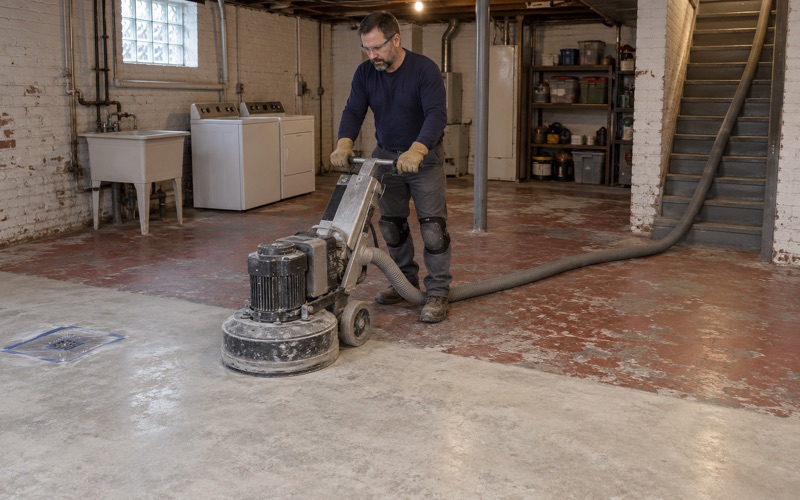
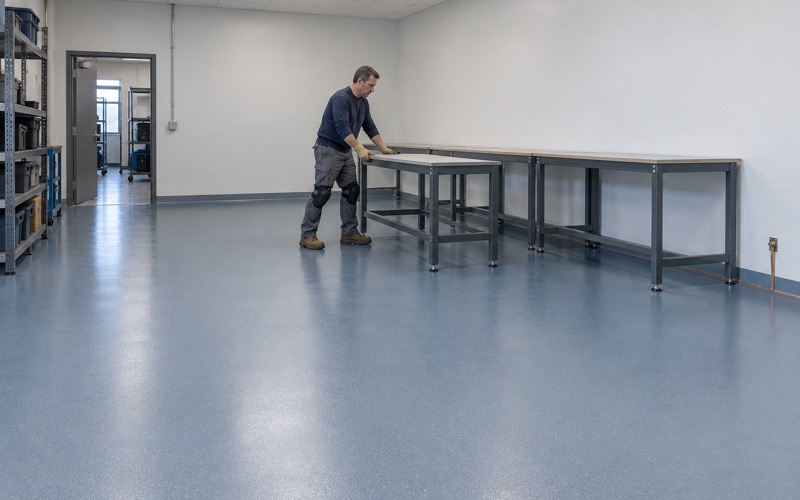
Berwyn Epoxy Flooring has spent more than 20 years on concrete floors, and our epoxy-flooring in Bridgeview work keeps coming back to one kind of room: the kitchen, prep area and walk-in behind a working storefront. Those floors take hot water, grease, cart wheels and daily scrubbing, and a coating has to stay bonded through all of it. We open every slab with a diamond grinder or a shot blaster before any resin goes down, and we never acid etch.
Before we quote, we look hard at what is already on the floor. Old coatings, patched cracks and tile adhesive tell us whether the slab can take a new system or needs repair first, and we say so plainly when it does. The written proposal names the product, the system build and the finished thickness, so an owner can check what went down against what was sold.
On a food-business floor, one question comes before color, texture or cure time: which public health department will look at the finished room. Here, the answer depends on the address, and we settle it before we write the scope.
Two Health Departments, One Avenue
Harlem Avenue does more than carry traffic through Bridgeview. For food businesses it can also mark the edge between two separate local health authorities, so a bakery, grocery or restaurant kitchen may answer to a different department than the shop across the street. The split is easy to miss, because both sides sit inside the same village and deal with the same village hall.
Bridgeview is a village in Cook County, about 15 miles southwest of the Chicago Loop, and it counted 17,027 residents at the 2020 census. Four townships, Lyons, Palos, Stickney and Worth, meet inside it at 87th Street and Harlem Avenue. Township lines are what move the health authority, which is why a single village can be served by two departments.
East of Harlem: the Stickney Public Health District
Parts of Bridgeview east of Harlem Avenue lie in Stickney Township, and food businesses there are served by the Stickney Public Health District. The district has provided public health services to township residents since 1946, keeps its main office at 5635 State Road in Burbank, and is certified as a local health department by the Illinois Department of Public Health.
Restaurant inspections and food permits sit under the district’s environmental health work, and a new establishment inside township boundaries obtains its food and drink permit from the district. When a kitchen floor is part of opening a new business in that part of the village, the permit conversation runs through Burbank rather than through the county.
West of Harlem: the Cook County Department of Public Health
The rest of the village is suburban Cook County, and food businesses there answer to the Cook County Department of Public Health. Its jurisdiction covers suburban Cook County but excludes Stickney Township, which has its own state-certified health department. That exclusion is why the county’s coverage stops partway through Bridgeview rather than at the village limits.
We do not guess which department a storefront falls under. We confirm the address and the township with the owner before the scope is written, and we leave it to that department to say what it expects of the finished room. A floor built to the wrong set of expectations is a floor that may have to be redone.
None of this changes how a floor is ground or coated. It changes who reviews a new food business, whose permit a recoat may touch, and whose inspector may walk the room when the work is done, and that shapes the schedule as much as the cure time does.
Looking for epoxy-flooring closer to Hinsdale? See Epoxy-Flooring Services in Hinsdale.
Bakery, Grocery and Restaurant Kitchen Floors on Harlem
Harlem Avenue in Bridgeview is home to a district of Arab-American businesses, including groceries, Middle Eastern bakeries and sweet shops, and restaurants. That stretch is where the village’s food-service floors concentrate, and those floors share a short list of problems no matter which department oversees them.
Dish and prep areas
Dish areas see standing water, detergent and the thermal shock of hot rinse water through every service. A thin roll-on coating rarely lasts there, so we build these rooms with urethane cement or a 100% solids epoxy base, broadcast with quartz aggregate where the floor needs grip when it is wet.
The model FDA Food Code allows slip-resistant floor surfaces where spills make them necessary, and it treats coved floor-to-wall junctures as a cleanability measure. Neither health department’s own preferences on color or cove detail are something we assume, so we ask the responsible department what it will look for at the walls and drains before the first kit is opened.
Many storefront kitchens carry quarry tile, old epoxy or a painted slab from a previous tenant. We grind a test area to see what the existing layers are bonded to, and if the slab under them is cracked or crumbling, we say that it needs repair before any coating is quoted. A new system laid over a failing one inherits the failure.
Walk-ins and cold rooms
A walk-in cooler floor runs cold, and a cold slab sits close to its dew point. Resin applied when the dew point spread at the slab surface is too tight can cure with amine blush or lose its bond, so we measure surface temperature and humidity on the day instead of trusting a forecast. Where a walk-in can be emptied and allowed to warm, we schedule the coating around that window.
Bakery and grocery sales floors
Flour, sugar syrup and strong cleaning chemicals are hard on a weak coating, and a grocery aisle adds pallet jacks and loaded carts. A vinyl flake broadcast under a polyaspartic topcoat hides wear well on a sales floor, while the back room usually gets the heavier build.
Grocery coolers and freezer cases sit on the sales floor too, and their condensate lines can leak onto the coating for years. We choose a topcoat there that handles constant damp, and we seal the edges where cases sit so water does not creep under them.
Older storefront slabs get moisture testing as a line item in the scope, with ASTM F2170 relative humidity probes or ASTM F1869 calcium chloride tests. Vapor rising through the concrete is how many coatings end up blistering, and moisture is the first exclusion we read out of the warranty before a job is sold.
Keeping a Storefront Open While the Floor Is Redone
A bakery that closes for a week loses more than a week of sales, and few food businesses can shut the front counter while the back of the house is redone. We plan these jobs around the hours the business has to keep running, including overnight and weekend windows.
Working in zones
We usually split a kitchen into zones, so one line or prep area stays usable while another is ground, coated and cured. Equipment moves in a planned order, and the zone that has to return to service first gets the faster-curing system.
Polyaspartic and polyurea topcoats return a floor to light use quickly, while urethane cement takes longer to reach full service but tolerates the heat a cooking line puts into the slab. We explain that tradeoff in the proposal, with the cure time for each zone written down, so the owner can plan staff and deliveries around it.
Every zone is opened to a surface profile matched to the system, using the ICRI concrete surface profile scale, so a thin topcoat and a thick urethane cement each get the texture they need to bond. The profile is set by grinding or shot blasting, and the same method runs from the first zone to the last.
Dust, odor and the shoppers out front
Grinding dust is collected at the machine with vacuum extraction and never washed toward a floor drain. That keeps the sales floor clean while customers are still a few feet away, and it keeps slurry out of the building’s plumbing.
We choose coatings within the Illinois limit on VOC content, which binds the installer as well as the manufacturer, and we plan ventilation with the owner before any product is opened. In a room where food is stored and sold, odor control is part of the schedule, not an afterthought.
Drains and what a coating cannot do
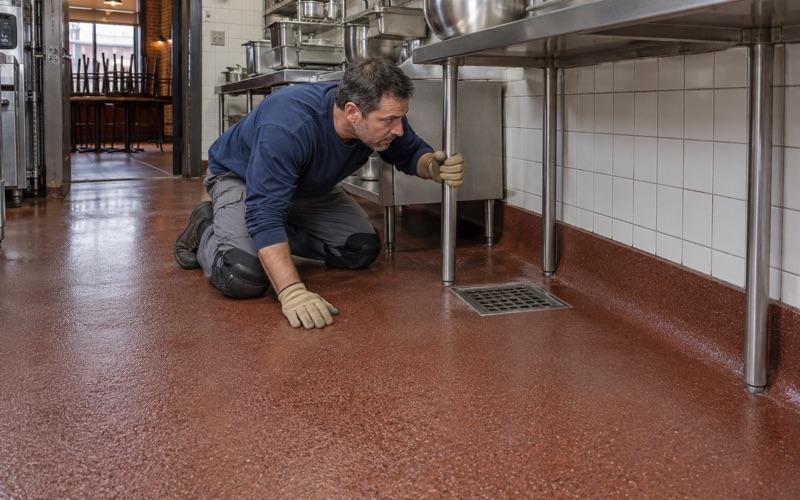
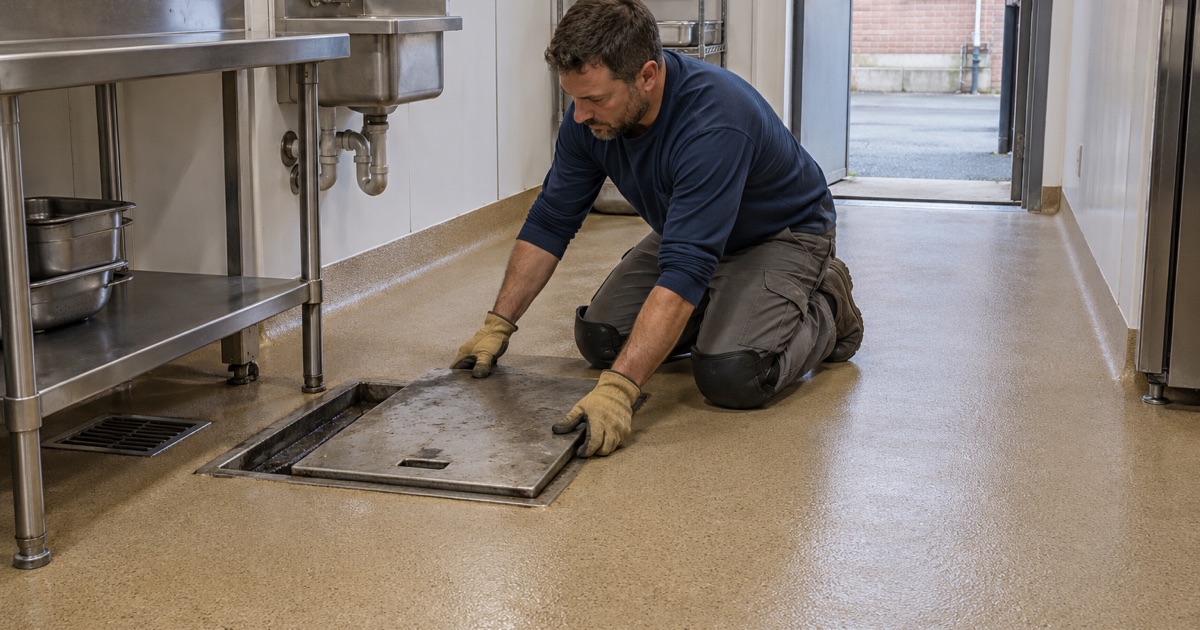
Kitchen slabs are full of floor drains, and they usually slope toward them. We detail the coating into each drain body so water runs off the surface rather than under the edge, which is where a kitchen floor tends to fail first.
A floor coating does not stop a sewer backup. When an owner raises that worry, we point to the drain and the backflow question first, and only then talk about resin.
The Village Building Permit Still Comes First
Whichever department issues the food and drink permit, the construction side belongs to the Village of Bridgeview Building Department, which works out of village hall at 7500 South Oketo Avenue. The two approvals run alongside each other, and neither one stands in for the other.
What the village asks for
Permit applicants submit a contractor’s license, a surety bond and a certificate of insurance, and the village issues no permit without drawings. Its adopted codes include the 2021 International Building Code and the 2015 edition of NFPA 101, the Life Safety Code.
Electrical work tied to a new kitchen layout falls under the City of Chicago Electrical Code the village has adopted, with electricians licensed by the City of Chicago. That trade is not ours, but we sequence the floor around it so new circuits and equipment pads are in place before the final coat goes down.
Illinois issues no state license for flooring or coatings work, so the village license, bond and insurance are the credentials that count here. We confirm them with the building department before a job goes on the calendar, not after.
Lining up both approvals
For a new food business, we work from the drawings the village reviews, so the floor in the permit set is the floor that gets installed. If the health department wants a particular finish or detail, we want to hear it while the drawings can still change.
For a recoat inside a kitchen that is already open, we ask the owner to check two things before demolition: whether the village wants a permit for the work, and whether the health department wants to see the room before it reopens. Getting both answers early keeps a finished floor from sitting idle while an inspection is booked.
- 20+ Years Coating Floors
- Moisture Tested Before Quoting
- Free Written Estimates