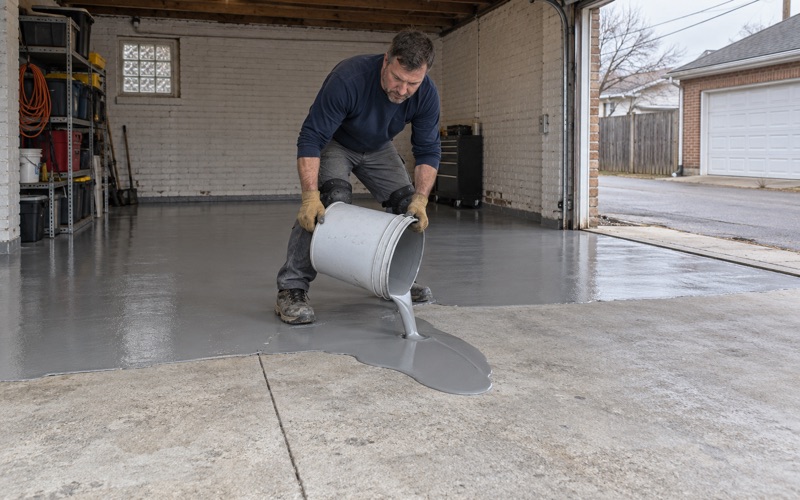
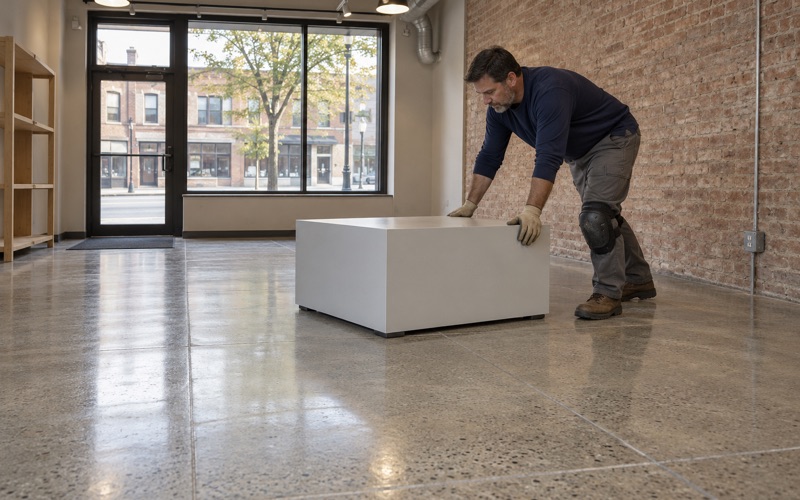
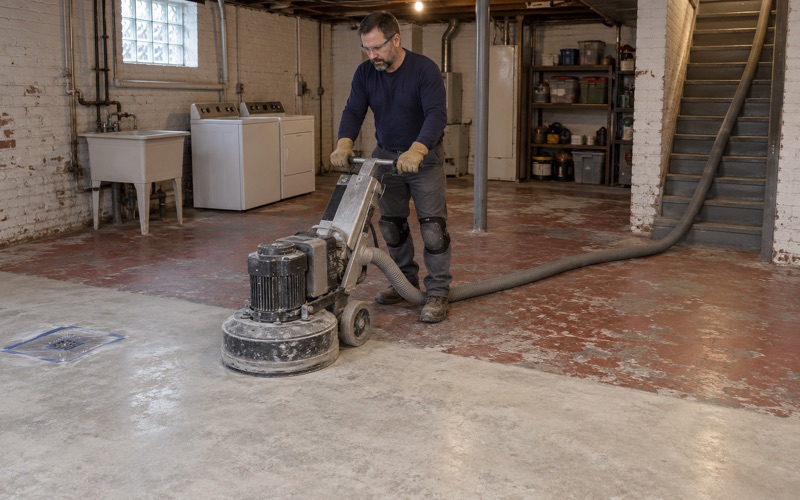
Berwyn Epoxy Flooring brings more than 20 years of epoxy flooring work to Bensenville, and every job starts with the slab rather than the color chart. We open the concrete with a diamond grinder or a shot blaster to a measured ICRI CSP profile, and we never acid etch. That mechanical profile is what the first coat actually grips.
Moisture testing sits in the written scope as its own line, whether the floor is a basement, an attached garage or a commercial back room. Depending on the slab, that means an ASTM F1869 calcium chloride test, ASTM F2170 in-situ relative humidity probes, or a quick ASTM D4263 plastic sheet check to decide whether more testing is needed.
This page looks at one local condition that most towns never have to think about: floors that live next to ice. The lessons carry straight into the garages and basements we coat across the village, because cold concrete, standing water and hard traffic behave the same way at any scale.
Three Sheets of Ice on East Jefferson Street
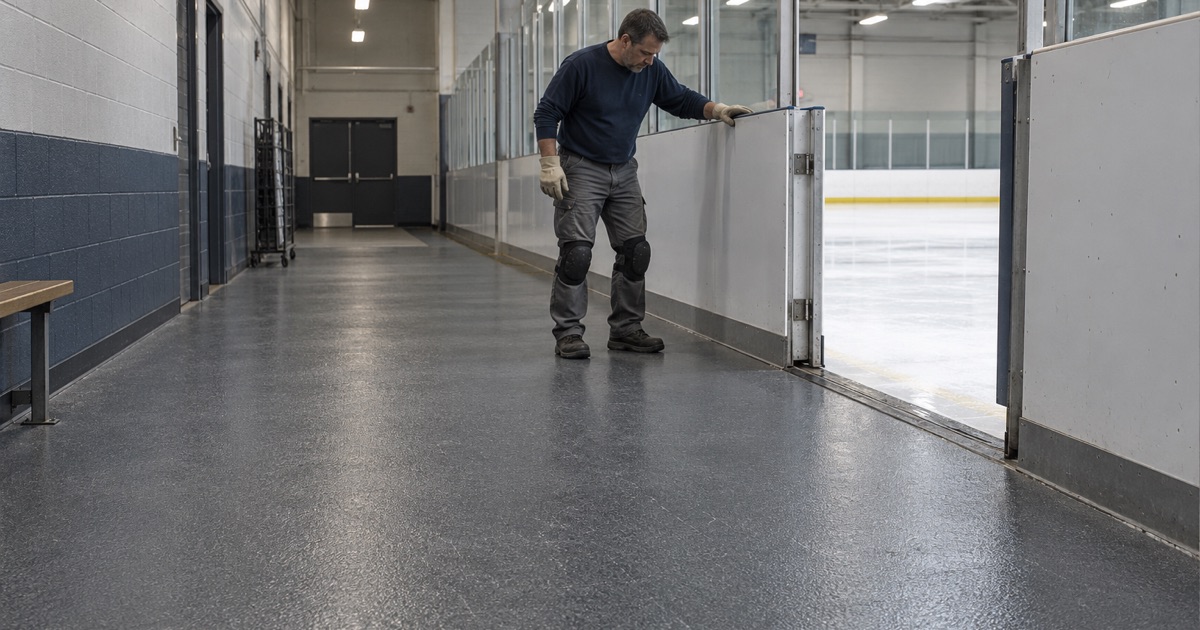
The Edge Ice Arenas sit at 735 East Jefferson Street, inside Bensenville village in Addison Township, DuPage County. The complex is owned by the Village of Bensenville and opened on October 1, 1997, with three ice sheets: one 200-by-90-foot sheet at The Edge on John Street and two NHL regulation-sized sheets at The Edge II. The village describes a main sheet seating 2,800 spectators, and the Chicago Blackhawks once used the building as a practice facility.
It is part of the Redmond Complex, which also holds a band shell, ball fields, courts and a climbing wall. We have not worked on the arena’s floors and have not inspected them. We name it because it is the clearest local example of a floor that has to handle blades, meltwater and cold concrete every day of the year.
That combination is rare, and it explains why one coating system never fits every room, even inside a single building. A rink’s lobby, its locker rooms and its resurfacer bay are three different floors that happen to share a roof.
What Skate Blades Do to a Floor
A skate blade is a narrow steel edge carrying a person’s full weight on a contact patch thinner than a pencil line. Walked across bare concrete or a thin coating, it scratches, gouges and chips, and it dulls the blade at the same time. That is why the usual surface where skaters walk on blades, from the locker room to the bench, is rubber matting rather than any resinous coating.
Where a Coating Belongs in a Blade Building
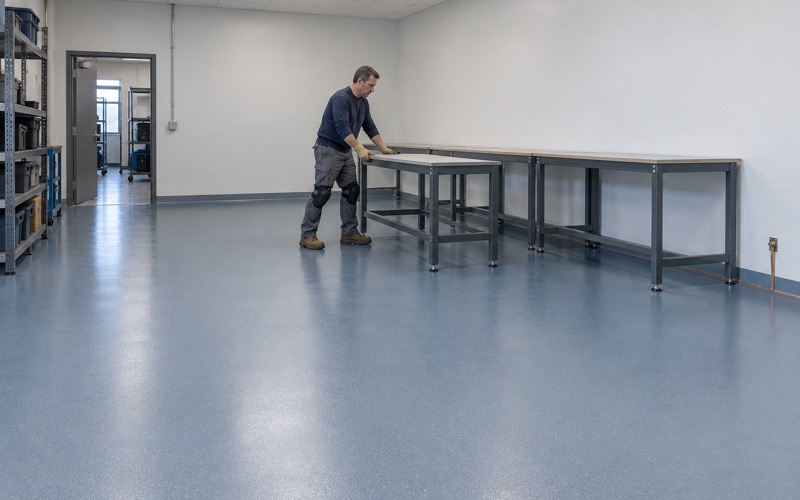
We say this plainly because it shapes the quote. In a building with skate traffic, a coating does its work around and under that matting: the bare slab beneath it, the corridors where people walk in shoes, and the rooms where water and equipment do more damage than steel edges. A 100% solids epoxy base with a quartz aggregate broadcast gives those areas a textured, sealed surface that a mop and squeegee can actually clean.
The same thinking applies at home. If a family stores hockey gear in a Bensenville garage or basement and someone laces up there, we plan a mat at that spot instead of promising a floor that shrugs off blades.
Looking for epoxy-flooring closer to Lincolnwood? See Epoxy-Flooring Services in Lincolnwood.
Meltwater, Snow Piles and the Resurfacer Room
Every pass of an ice resurfacer shaves the sheet and lays down fresh water, and the shavings have to go somewhere. In a typical rink they are dumped as a snow pile in the resurfacer room, where they melt across the floor toward a drain or pit. Add the machine’s own tire traffic and the water it drips coming off the ice, and that room is one of the wettest, hardest-working floors in the building.
Building a Floor That Stays Underwater Part of the Day
For a room like that, a thin roll-on coat is the wrong tool. Urethane cement is the system we reach for where a slab sees standing water, temperature swings and heavy wheels together, because it tolerates thermal shock better than a standard epoxy build. A broadcast of quartz aggregate keeps it from turning slick when it is wet, and the slope to the drain is checked before anything is applied.
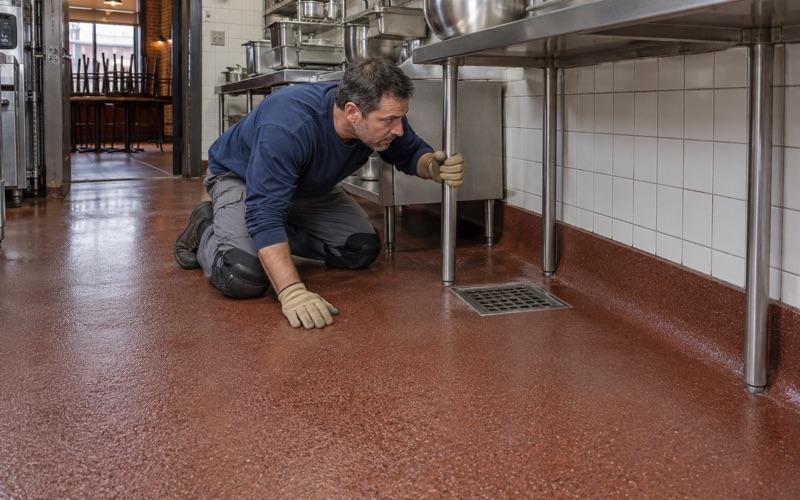
Drains and pits need their own detailing. We cut the coating into a keyway at the edge of each sump pit and floor drain so water cannot get under it, and we cove the floor up the wall where water collects against it.
Wet Gear, Wet Floors
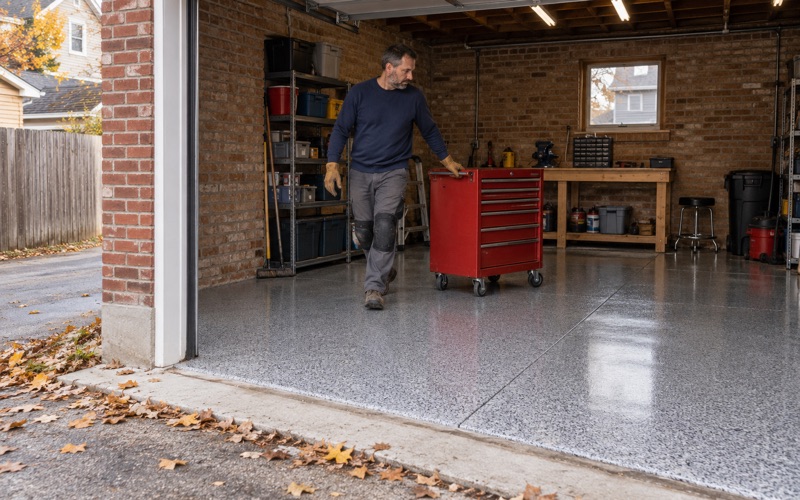
Meltwater does not stay in the resurfacer room. It comes off skates, bags and boots into hallways and locker areas, and it rides home in the trunk to drip onto a garage floor. A coated garage handles that well as long as the texture matches the use: a vinyl flake broadcast under a polyaspartic topcoat gives grip and hides spots, while a glossy smooth finish turns hazardous under wet socks.
Surface water is only half of it; a slab can also push moisture up from below. That is why our moisture test comes before the product choice, not after a blister shows up.
A Cold Building on a Cold Slab
Refrigerated ice keeps the building cool, and the concrete close to a sheet can run colder than the air above it. When the slab surface drops near the dew point, moisture condenses on it. A coating applied to a damp, cold surface can fail to bond, cure slowly or come out cloudy and tacky.
Reading the Dew Point Spread
We measure slab temperature, air temperature and relative humidity on site and work from the dew point spread at the slab surface, not from the date on the calendar. Our rule is simple: if the slab is not comfortably warmer than the dew point, the coating waits. That discipline matters most in a cold room, and it matters just as much in an unheated detached garage in early spring.
Sometimes the honest answer is that a detached garage has to wait for spring. We would rather tell you that up front than put down a floor that never fully cures.
Amine Blush and Hot Tire Pickup
Cool, damp conditions during cure are what bring out amine blush, a waxy film on the surface of some epoxies that weakens the bond of the next coat. We check for it and remove it before topcoating rather than burying it. Where a fast return to service matters, a polyaspartic topcoat cures across a wider temperature range than most epoxies, which helps in a cold building.
Hot tire pickup is the opposite problem and shows up in garages. Warm tires pulled in off the road can lift a weak or thin coating, which is why we build garage floors at a real film thickness and over a ground profile, never over a slick or etched surface.
Moisture From Below
A cold slab can also be a wet one. When hydrostatic pressure pushes vapor up through concrete, it shows as efflorescence, darkened patches or a coating that lifts in blisters. Where our ASTM F2170 readings or calcium chloride results come back high against the ASTM F710 thresholds, we specify a moisture-mitigation primer before the build coats, or we tell you the floor is not a good candidate.
Mechanical and Refrigeration Rooms
The rooms that make the ice are their own kind of floor. Compressors, pumps and piping drip condensate, and maintenance means tools, carts and the occasional chemical spill on concrete that rarely warms up. A sealed, coved floor with a textured finish makes leaks visible and cleanup quick, which is the same reason we recommend one for a home mechanical room or a shop corner with a sump pit.
Working Around a Building That Never Really Closes
An ice complex runs on a schedule that barely pauses, with hockey practices and games spread through the year. Floor work in a building like that is planned around the hours it has to keep running, including overnight and weekend windows, and around how long each product needs before it can take foot traffic or wheels. Commercial owners in Bensenville face the same puzzle in any facility that cannot simply shut its doors for a week.
Phasing the Work Room by Room
We break a job like that into zones so part of the floor stays open while another part cures. Dust from diamond grinding is collected at the tool with a vacuum, which keeps it out of the air handling and off the surfaces next door. Each zone is tested, ground, coated and handed back before the next one starts.
Reading the Slab Before We Price It
Older commercial slabs and home floors alike tend to carry a history. We read the cracks, the patches and any old coating before we quote, and we say plainly when a slab needs repair or replacement before a coating will last. Warranty exclusions are read out before the job is sold, with moisture named first.
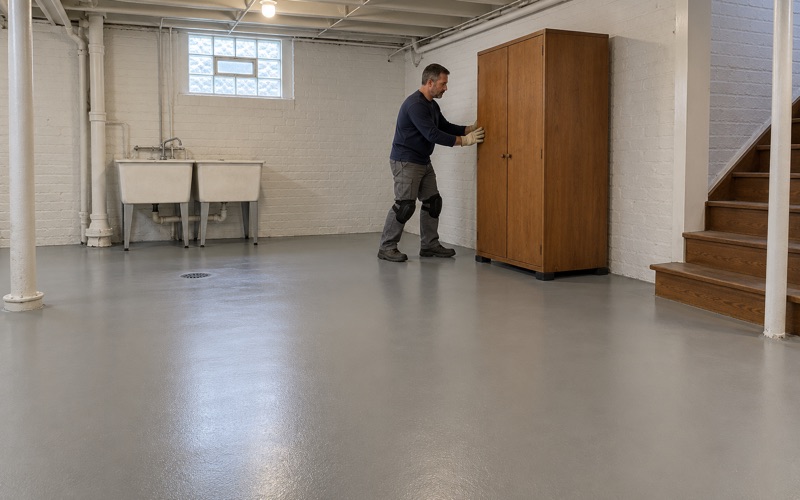
That matters in a village where 73.8 percent of the 7,283 housing units predate 1980. A basement floor in an older home may hold paint, patches or old adhesive, and we check for each before choosing a system, because a coating is only as sound as the layer it sits on.
Paperwork for Home Jobs
Every home job comes with a written contract and the Home Repair: Know Your Consumer Rights pamphlet before any work begins, as the Illinois Home Repair and Remodeling Act requires. Coatings are selected within the Illinois VOC content limits, which apply to the installer as well as the manufacturer. And we do not present a floor coating as radon reduction; in Illinois, that work requires a state radon mitigation license.
What a Bensenville Quote Includes
A quote from us lists the moisture test method, the surface preparation, the named product and system, the finished thickness and the cure window before traffic. If the slab is cold, we add the temperature and dew point conditions the work depends on, so a delayed start is explained in writing rather than discovered on the day. That way a homeowner with a garage on a quiet street and a facility manager with a service room can both check the floor against the paper.
- 20+ Years Coating Floors
- Moisture Tested Before Quoting
- Free Written Estimates