Berwyn Epoxy Flooring brings more than 20 years of epoxy-flooring in Bellwood work to the slab in front of us, whether it carries a pallet jack, a delivery van or the family car. We start every job by asking what will roll across the concrete, how heavy it is and how often, because that answer decides the system long before color or finish comes up.
On commercial work the honest answer is sometimes that a floor needs no coating at all. A densified and sealed slab, a careful joint fill or a full resin build can each be the right call, and we would rather talk a manager out of a coating than sell one that peels in the first busy season. Homeowners get the same plain reading of their garage or basement slab.
What follows is how we think about industrial and commercial floors here, where the traffic is heavier than most coating brochures assume, and how that thinking carries down to residential jobs.
Warehouse Space Rising Along 25th Avenue
Bellwood is a village in Proviso Township, Cook County, roughly 13 miles west of the Chicago Loop. Industry is not new here: after World War II, large employers settled in the eastern part of the village along the Indiana Harbor Belt tracks. The newer chapter is happening on 25th Avenue, where older industrial sites are giving way to modern high-bay buildings.
A 190,000-square-foot building at 840 25th Avenue
Ryan Companies and Washington Capital Management started construction of a 190,000-square-foot speculative industrial building at 840 25th Avenue, on the site of the former SureBuilt building. It is designed with a 32-foot clear height and ESFR fire protection, and it is aimed at uses from warehousing and distribution through light manufacturing. Completion is targeted for spring 2027, so for now it is a construction site rather than an operating floor.
We have no role in that project and have not seen its floor specification. We bring it up because it shows what kind of commercial space the corridor is turning into, and that shapes the questions a Bellwood tenant or owner should be asking about concrete.
What 32 feet of clear height means at floor level
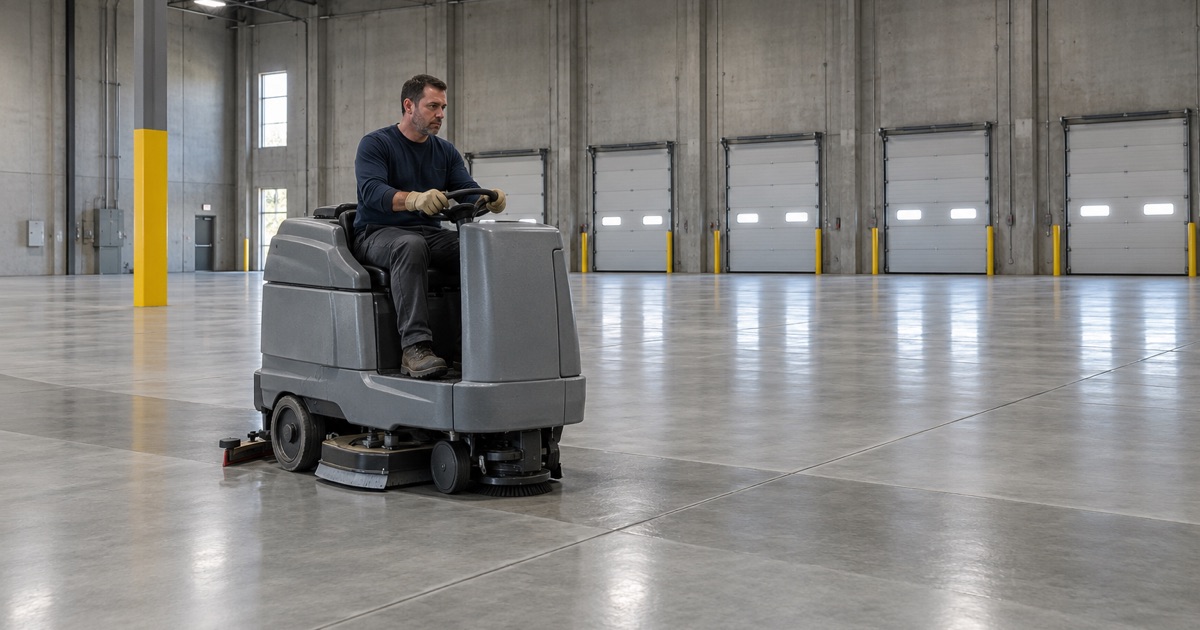
A 32-foot-clear building is built to be racked high. Tall racking means reach trucks and order pickers, concentrated point loads at every upright, and narrow aisles where the same wheels follow the same path over and over through every shift. The slab under that kind of operation is a working surface, and it is judged by how it handles wheels and anchors rather than by how it looks on move-in day.
That is true at any scale. A smaller shop, a contractor yard or a light-assembly bay elsewhere in the village faces the same forces, only with fewer aisles.
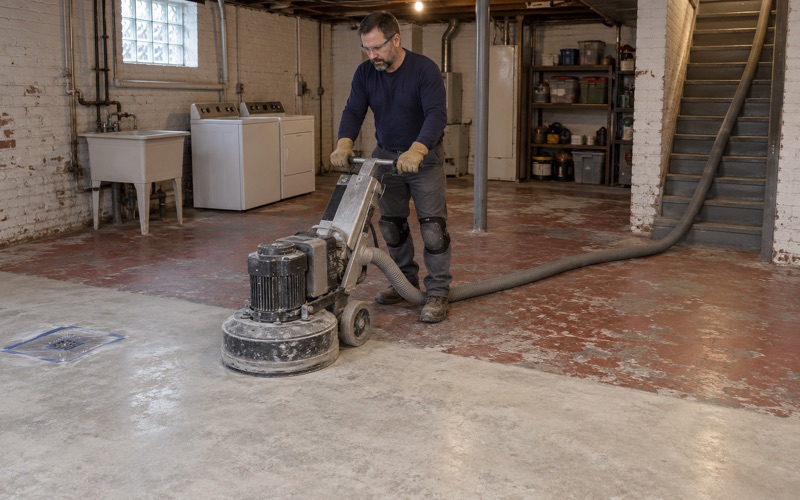
Older floors on the east side of the village tell a different story than a new slab. Decades of oil, patching and earlier coatings sit on some of them, and we grind test areas to see what is underneath before we commit to a system. Where the concrete itself has failed, we say so plainly and quote the repair or replacement before any coating.
Looking for epoxy-flooring closer to River Grove? See Epoxy-Flooring in River Grove.
Hard Wheels and Saw-Cut Joints
Most warehouse floors that fail do not fail in the open field of the slab. They fail at the joints, at the dock and around the rack feet, where loads concentrate and the concrete has an edge to lose.
Forklift traffic across joints
Saw-cut control joints are there so the slab cracks where it is told to. Every joint also leaves two exposed edges, and hard polyurethane or steel forklift wheels hammer those edges with each crossing. An unfilled joint spalls a little at a time, the spall catches the next wheel harder, and before long the aisle has a rut that shakes the load and the driver.
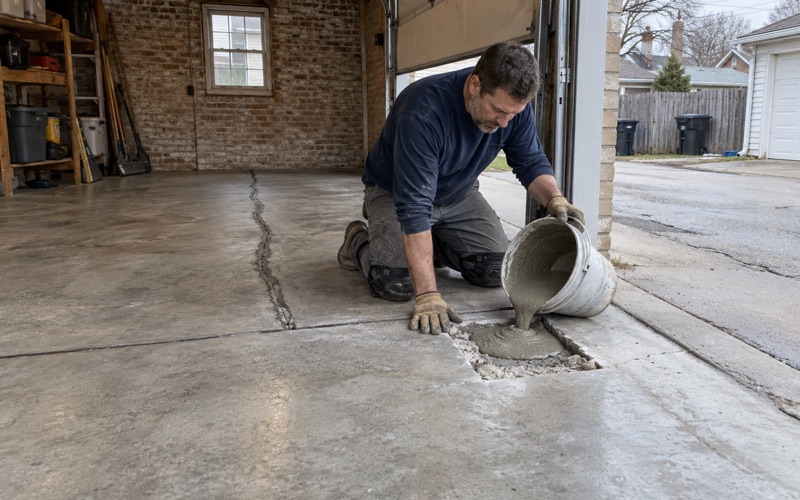
We look at joints first on any commercial walkthrough. If the edges are already broken, we talk about rebuilding them before anything is applied to the surrounding concrete, because a coating laid over a crumbling edge simply breaks along with it.
Why a film coating can be the wrong answer
A thin coating that bridges a moving joint will crack along that line, and under forklift traffic the crack becomes a lifting edge. Where a joint is still moving, a semi-rigid filler that supports the edge yet tolerates small movement usually serves better than a resin film run straight across it. On some high-traffic floors the right plan is to coat the field, honor the joints and fill them separately.
We also watch for hot tire pickup in areas where trucks park or turn on a fresh coating. A topcoat matched to the traffic and given its full cure prevents most of it.
Docks, Rack Anchors and the First Year of Use
The first year in a new or newly leased space tells you whether the floor plan was right. Docks and racking are where we see the earliest damage.
Dock doors
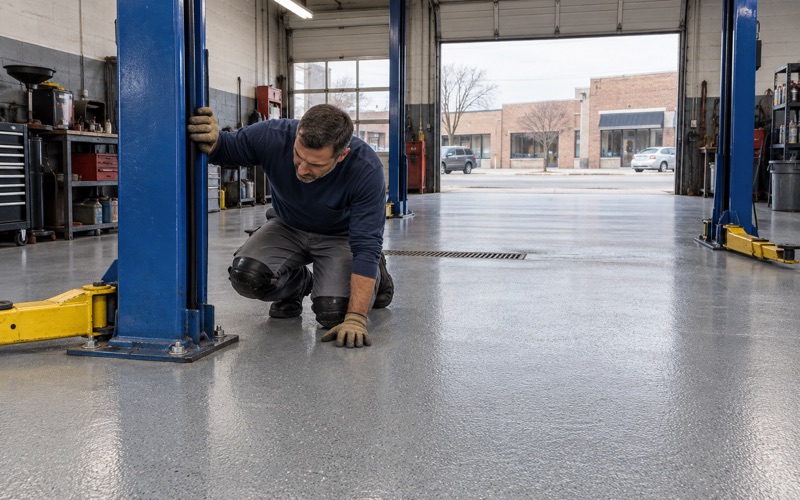
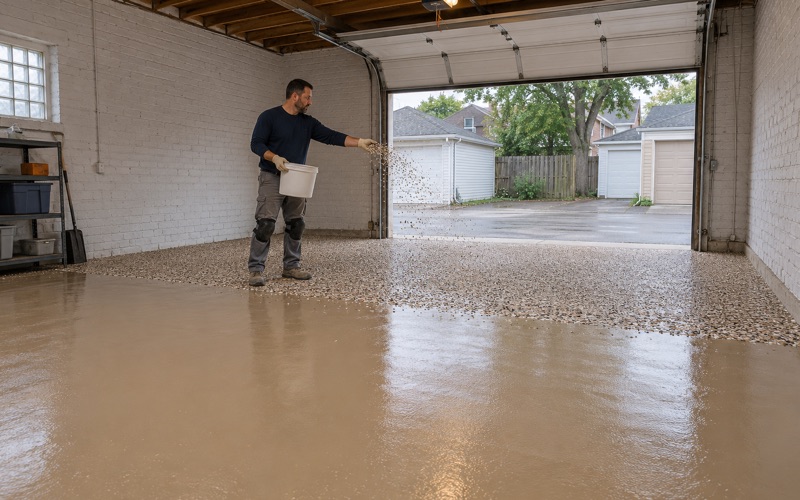
The floor just inside a dock door takes the hardest punishment in the building. Trailers bounce, pallet jacks drop, and in a Cook County winter the area collects meltwater, grit and deicer tracked in from the apron. A coating there needs more build and better slip resistance than the main aisles, and quartz aggregate broadcast into the resin is one way we add texture without making the floor hard to clean.
We keep that zone on a separate line in the proposal. It usually gets the heaviest system on the floor, and an owner should be able to see exactly why it costs more per square foot.
Rack anchors and upright plates
Every rack upright is bolted through a base plate into the slab, and those anchors carry heavy point loads. If a floor will be coated, the timing matters: coating first and drilling later leaves fractured edges at every anchor hole, while racking first means working around hundreds of plates. We plan the sequence with the owner and the racking installer so the floor is not damaged on day two.
Scheduling around a running operation
An occupied warehouse or shop rarely shuts down for a floor. We phase the work by zone and run overnight or weekend windows where needed, so receiving and shipping keep moving while one section cures.
Cure windows matter here too. A section reopened to forklifts before the topcoat reaches full cure is where early scuffing and wheel marking start, so we post the return-to-service time for each zone in writing and hold to it.
Seal, Densify, Fill or Coat
There is no single correct floor for a high-bay building. The right system depends on what the space stores, what rolls across it, and what the owner needs to clean off it.
Densify and seal
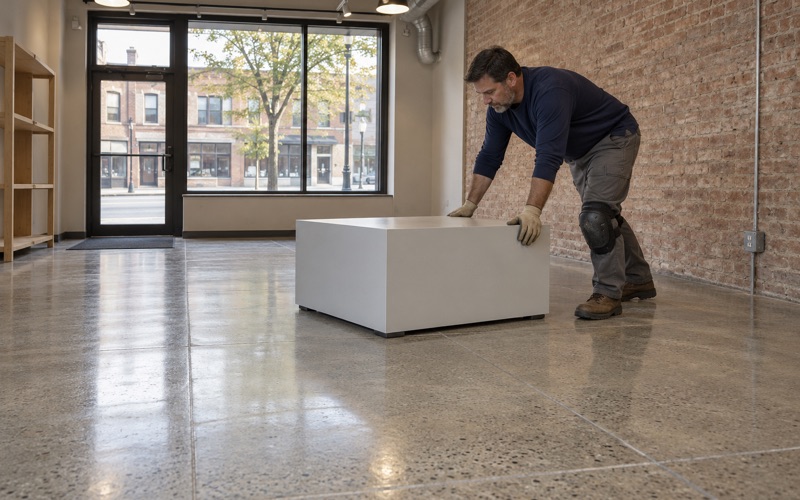
For many dry-goods warehouses, a lithium silicate densifier with a penetrating sealer is the most durable and least fussy choice. It hardens the surface, cuts dusting, and leaves no film for a forklift wheel to lift. It will not stop chemical spills from staining, and it will not hide wear, but it rarely fails outright.
Fill the joints
Joint filling stands on its own as a scope item. On a densified floor it may be the only other work required, and on a coated floor it protects the system where it is most likely to break. We price it separately so the owner can see the joint work rather than having it buried inside a coating quote.
Coat the floor
Where a light-manufacturing line, a wash-down area or a chemical zone needs a sealed, cleanable surface, a 100% solids epoxy base with a polyaspartic or polyurea topcoat is a common build. Heavier service, including thermal shock or harsh cleaners, may call for urethane cement instead. Areas with sensitive electronics can need static-dissipative or ESD flooring, specified to a measured resistance range rather than a marketing label.
How we quote it
Every coated slab is opened mechanically by diamond grinding or shot blasting to a measured ICRI CSP surface profile, and we do not acid etch. We run moisture testing with ASTM F2170 in-situ relative humidity probes or ASTM F1869 calcium chloride kits before choosing a primer, and a moisture-mitigation primer goes into the plan only when the numbers call for it. The proposal names the product, the system build and the finished thickness, and the warranty exclusions are read out before anyone signs, moisture first.
Our coatings are chosen within the Illinois VOC limits under Part 223 of Title 35 of the Illinois Administrative Code, which bind the installer as well as the manufacturer. Illinois issues no state license for coatings work, so before a job goes on the calendar we confirm what the Village of Bellwood Building Department expects for contractor registration, bonding and insurance.
Bringing it home
The same reasoning holds on a Bellwood garage. A car is lighter than a forklift, but tires still pound the same spots, winter salt still collects at the door, and a floor still fails at its weakest edge.
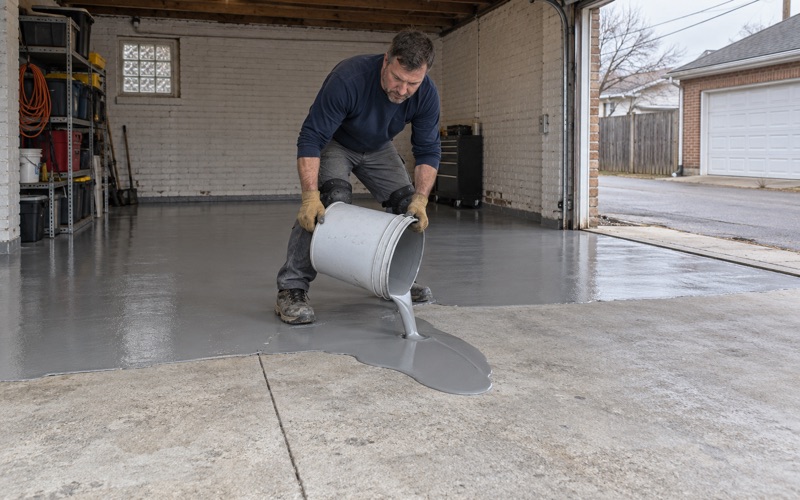
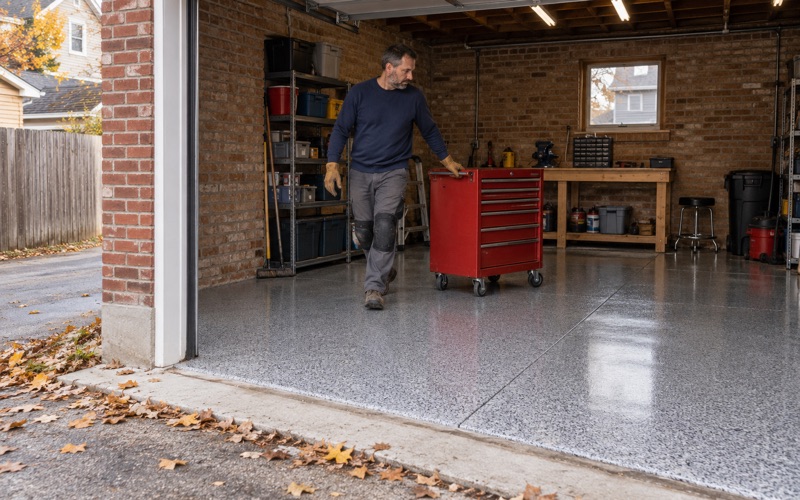
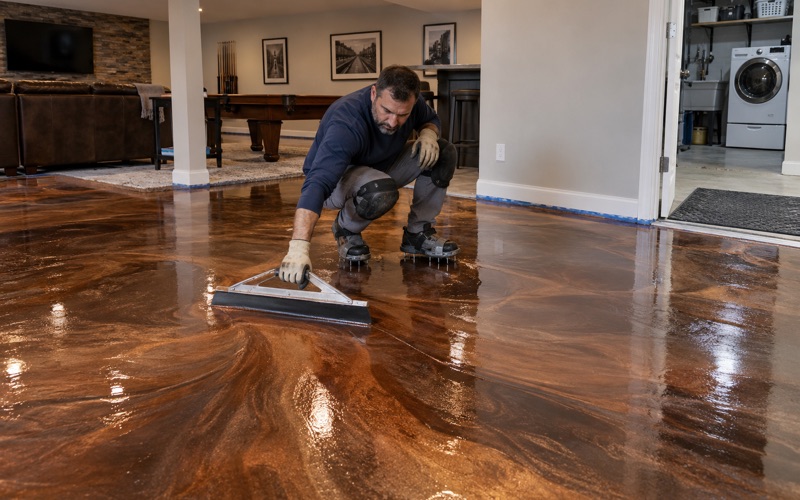
For a garage we build for the calcium chloride brine and rock salt that ride in on tires all winter, which usually means a 100% solids epoxy base, a vinyl flake broadcast and a polyaspartic topcoat that resists the brine. We read the cracks and any old coating on a home slab too, and a garage that has heaved or settled past repair gets that verdict before any price for a coating. Moisture testing is on the garage quote just as it is on a warehouse one.
Curing follows slab temperature and dew point rather than a date on the calendar. An unheated detached garage in January is often too cold for a resin to cure properly, and when that is the case we tell the owner plainly that the job should wait for spring. Every home job gets a written contract and the state’s Home Repair: Know Your Consumer Rights pamphlet before work begins, as the Illinois Home Repair and Remodeling Act requires.
- 20+ Years Coating Floors
- Moisture Tested Before Quoting
- Free Written Estimates