Berwyn Epoxy Flooring has spent more than 20 years on epoxy flooring in Alsip and the surrounding suburbs, and the work here splits cleanly in two. On one side are production floors that get scrubbed, sanitized and inspected on a schedule someone else writes. On the other are garages poured decades ago that now need a coating able to take a winter of road brine.
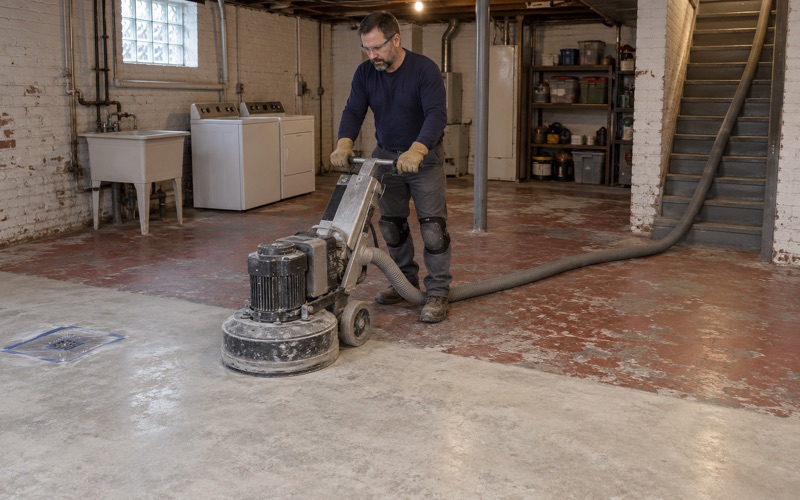
Either way, the floor starts in the same place. We open every slab with a diamond grinder or a shot blaster, never acid, and moisture testing appears on the proposal as its own line rather than turning up as an excuse after a coating has lifted. The proposal also names the product, the system build and the finished thickness, so anyone can hold what was quoted against what was installed.
Before we price anything, we look hard at the cracks and whatever coating is already down. If a slab needs repair or replacement before it can carry a coating, we say so at the walk-through, and we read the warranty exclusions aloud before you sign, starting with moisture.
A Seasoning and Coatings Plant on Central Avenue
Alsip is a village in Cook County, a south suburb of Chicago, and it is home to the international headquarters of Griffith Foods at 12200 S Central Ave. The address sits inside the village, in Worth Township. Griffith develops and manufactures dry seasonings, sauces and dressings, and coating systems, and a current posting for a mixing operator onsite in Alsip gives a plain picture of what a production floor there has to live through.
That posting describes adding raw materials to a blender in a set sequence, discharging blended product through a prescribed screen size, and cleaning and sanitizing the production equipment, tools and work area. It also asks for someone comfortable working with and around allergens and cleaning chemicals. We have not been inside that plant and have not seen its floors, but those duties describe the conditions any floor in a dry-blending room has to answer.
Powder on every surface
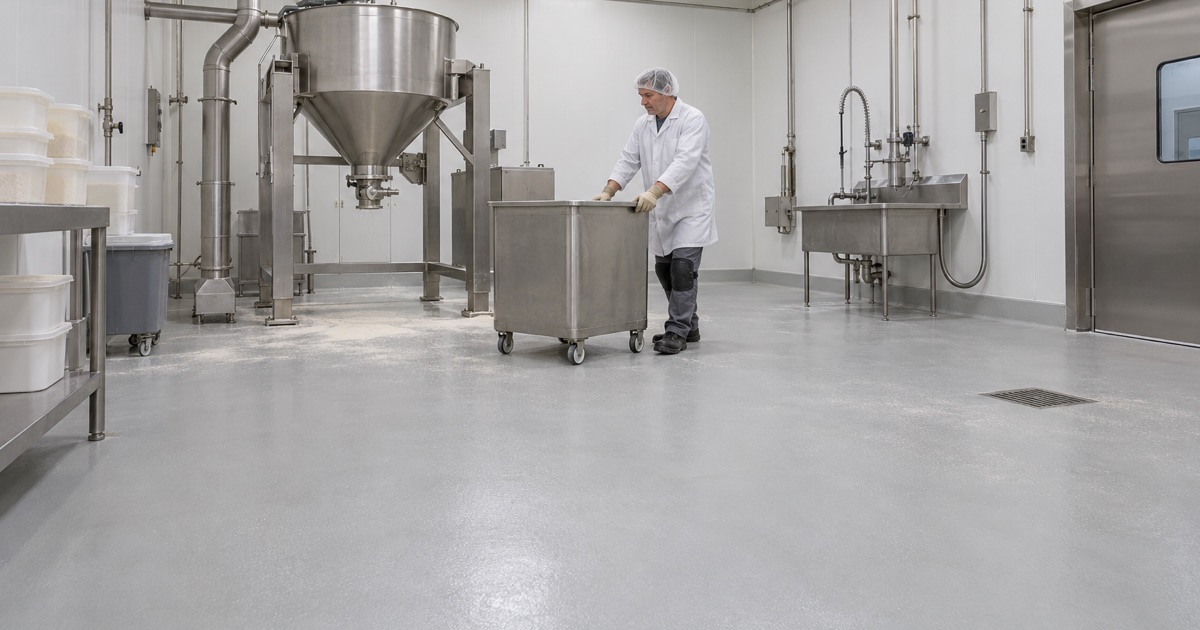
Dry ingredient work leaves fine powder on every horizontal surface, and the floor collects the most of it. A textured broadcast floor gives footing, yet too sharp a profile holds powder in the valleys and makes the cleanup crew work harder than it should. In a blending room we usually talk about a finer quartz aggregate broadcast locked under a sealing topcoat, so the surface has grip without deep pockets.
Wash-down and sanitation chemicals
The bigger test is the cleaning routine. Floors that get scrubbed and sanitized between runs see hot water, detergents and sanitizers day after day, and a thin coating rolled over a poorly prepared slab tends to soften, haze or lift at the edges under that cycle. For that exposure we look at urethane cement or a 100% solids epoxy system built to a real thickness, with the plant’s own chemical list checked against the manufacturer’s resistance data before anything is ordered.
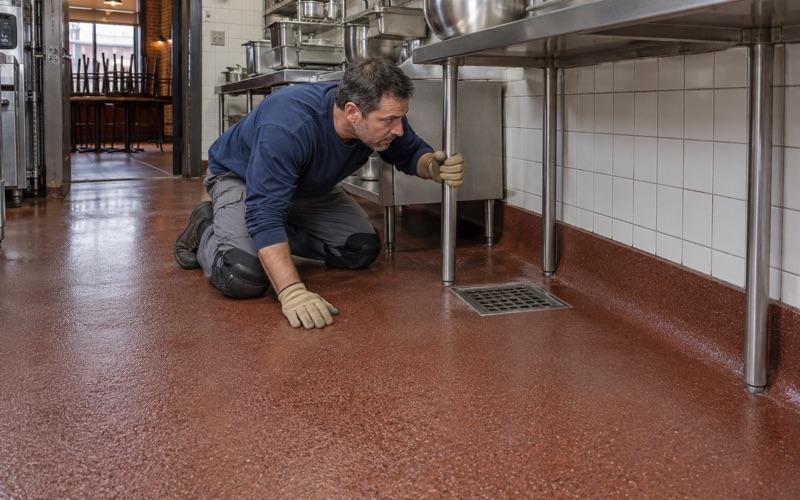
Coves matter as much as the open field of the floor. Where the floor meets the wall, the coating should turn up into a sealed cove so wash water and powder have no seam to hide in. Drains get detailed too, so the coating terminates cleanly instead of feathering out at the grate.
Looking for epoxy-flooring closer to Palos Heights? See Epoxy-Flooring in Palos Heights.
Allergen Changeovers Inside an Audited Program
Allergen control is where a floor stops being a surface and becomes part of a process. When a line moves from a product carrying one allergen to a product that must be free of it, the room has to clean out completely, and that includes the floor under and around the equipment. Every crack, open joint, chipped edge and porous patch is a place residue can survive a wash.
What a floor that cleans out looks like
In practice that means a continuous, nonporous surface with no exposed concrete, sealed joints, repaired spalls, and coving at the walls and around equipment bases. It also means a topcoat that does not chalk or pit over time, because a worn coating starts to hold material the way bare concrete does. We read the existing floor for those failure points before quoting, and we tell an owner plainly when a damaged area needs repair rather than another coat.
Working under someone else’s rules
The same posting mentions British Retail Consortium (BRC) audit requirements. We hold no food-safety or BRC certification, and we will not tell a plant what an auditor wants to see. The plant’s quality and sanitation staff set those rules, and our job is to fit the installation inside them.
That shapes everything from the product list to the schedule. We ask for the plant’s approved chemicals, its requirements for odor and cure before production resumes, and its rules on who may enter which room. Installation then runs on the plant’s own calendar, including overnight and weekend windows when a line can be shut down, with the work area isolated so grinding dust stays where it is collected.
Moisture under an older industrial slab
Industrial slabs often carry old coatings, patches and oil, and a few carry moisture that nobody has measured. Testing with ASTM F2170 in-situ relative humidity probes or ASTM F1869 calcium chloride kits is part of our scope rather than an option. When the readings call for it, a moisture-mitigation primer goes down before the build coats. A simple ASTM D4263 plastic sheet test can flag a problem on a quick visit, but it is not a measurement, and we do not size a primer from it.
Industrial Alsip Beyond the Plant Gate
The village describes itself as about 60% residential and 40% commercial and industrial, and it grew after the Tri-State Tollway was built in 1959. I-294 still runs through it, as does the Calumet Sag Channel, and the name goes back to Frank Alsip, who opened a brickyard here in 1885.
That industrial share means warehouses, shops and service bays as well as food production. Each one starts with the same question about how the floor is actually used: forklifts and pallet jacks, chemicals, standing water, or simply foot traffic and a need to sweep easily.
Matching the system to the use
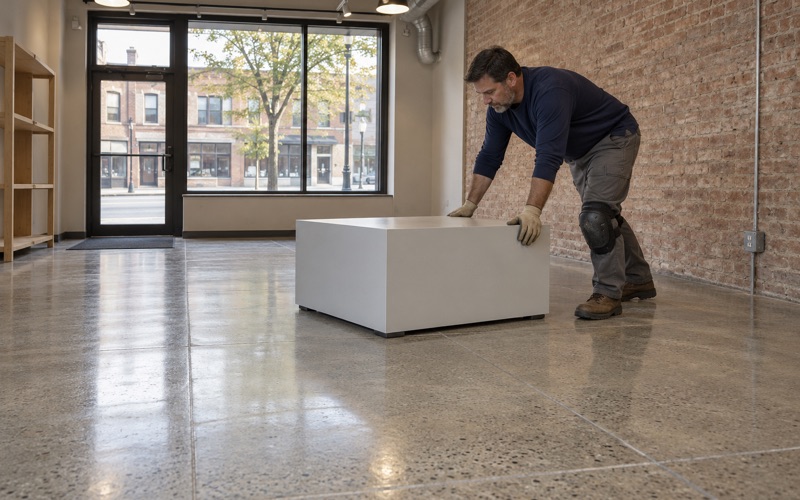
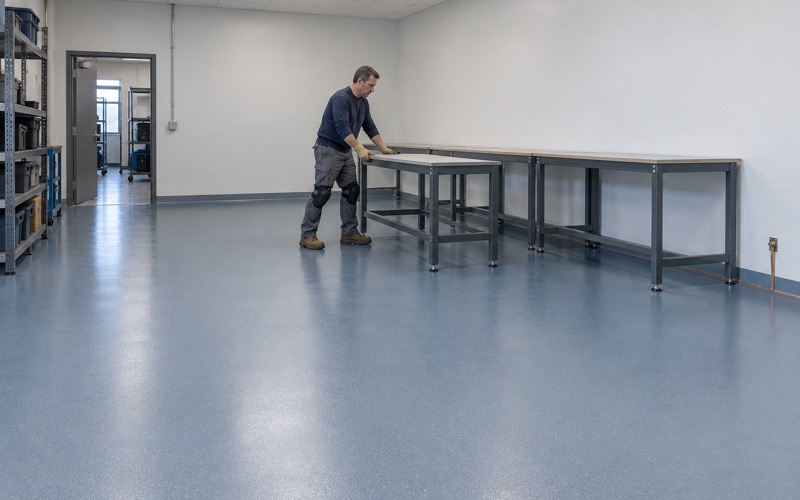
For warehouse aisles and shop floors we often build a 100% solids epoxy with a polyaspartic or urethane topcoat, sized to the traffic and the cleaning method. Mechanical rooms and light assembly areas may need nothing more than a densified, sealed slab. Where electronics are handled, we can talk through static-dissipative flooring and the resistance range the equipment calls for.
Prep in a working building runs on dust collection, with the grinder or shot blaster vacuumed at the head and nothing rinsed toward a floor drain. A shot-blasted profile gives the coating something to grip, which is what keeps a forklift aisle from delaminating at the first hard turn.
Village rules and state limits
Building work in Alsip runs through the Village of Alsip Building Department, under a building code the village adopted in 2007 on an International Building Code basis. Illinois issues no state license for flooring or coatings contractors, so we confirm the local license, bond and insurance requirements before a job is scheduled rather than assuming them.
Coatings also have to fall within the Illinois VOC limits for architectural coatings, which bind the installer and not only the manufacturer. On an occupied industrial floor, a lower-odor system is often the practical choice anyway.
Home Garages Over 1970s Slabs
Most of Alsip’s housing went up between 1960 and 1999, with the 1970s the single biggest decade, and only 15 units are counted from 2010 onward. That makes nearly every residential floor here a retrofit over a slab somewhere around 25 to 65 years old.
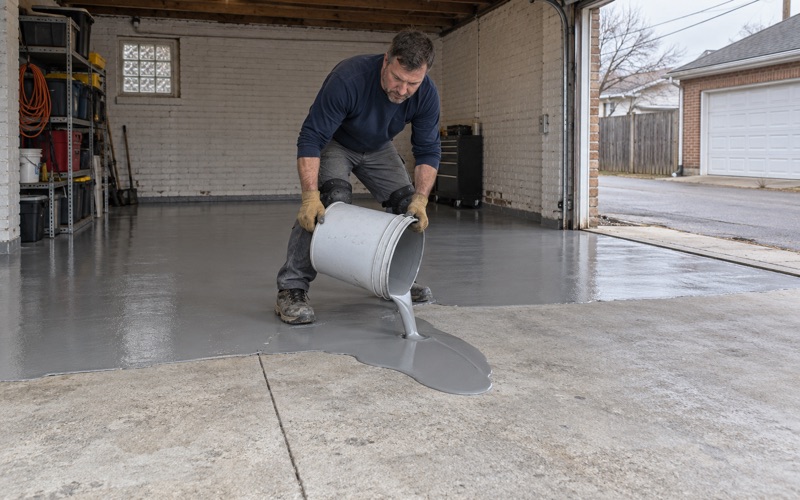
Single-family detached houses make up the largest share of the village’s housing, so garages are the floors we are most often asked about. A slab that age has usually seen decades of road salt, oil drips and patchwork repairs, and sometimes a previous coating that has started to peel.
Attached garages share a wall and often a door with the house, so we plan ventilation and odor around the people still living inside. Detached garages are simpler on that front, but they bring the cold-slab question covered below.
Prep and moisture on an older slab
We grind or shot blast the whole floor to the ICRI concrete surface profile the system calls for, which removes old paint and sealer along with the weak top layer. A garage slab may have no vapor retarder beneath it, so we test before we choose a system instead of guessing from the look of the surface.
Cracks get read rather than buried. Some are stable shrinkage cracks we can fill and coat over, while others show settlement or heaving that a coating will simply mirror, and we say so before quoting.
Built for a Cook County winter
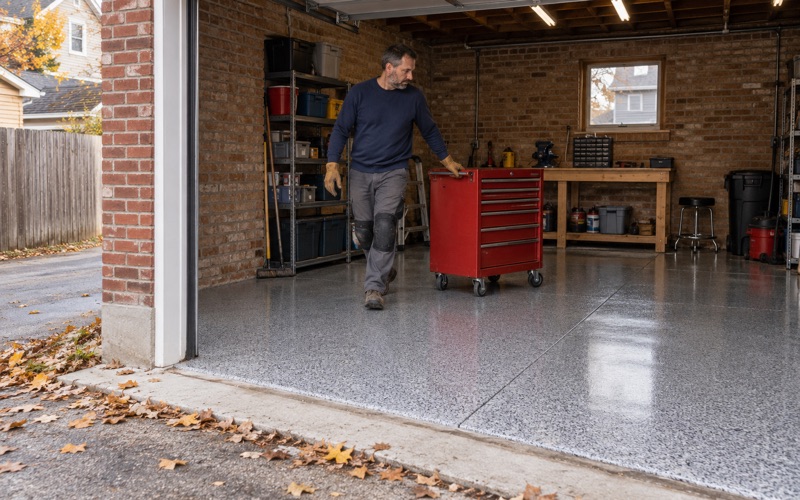
Calcium chloride brine and rock salt ride in on the tires all winter, and that is what a garage system here is designed around. A typical build is a 100% solids epoxy base with a vinyl flake broadcast and a polyaspartic topcoat, which resists hot tire pickup and wipes clean of salt residue.
Curing follows slab temperature and the dew point spread at the surface, not the calendar. An attached garage can often be done through much of the year, but when a detached garage is unheated and the slab is too cold, we tell you plainly that the job has to wait for spring.
Amine blush is the other cold-weather risk. When a curing epoxy sits in damp, cool air, a waxy film can form on the surface, and a topcoat placed over it will not bond the way it should, so we check for it and clean it off before the next coat.
Paperwork before the first pass
Every home job gets a written contract and the Home Repair: Know Your Consumer Rights pamphlet before work starts, as the Illinois Home Repair and Remodeling Act requires. We also say plainly that a floor coating is not radon reduction, because in Illinois that work takes a state radon mitigation license.
- 20+ Years Coating Floors
- Moisture Tested Before Quoting
- Free Written Estimates